
When putting an activity on the floor for the first time, we usually, as a group, go through a series of steps to try and make the final experience as satisfying and deep as possible for the visitor. We do a lot of these things intuitively, so I thought it would be a good exercise to reflect post-hoc on some of these steps, taking our recent Light Painting foray as an example. Maybe this will help me figure out why we think certain details are important, and can be of use to someone else thinking of hosting their own activity.
In the weeks prior to the event, we usually spend some time, as a group, playing around with the phenomenon. We try and encourage each member of our group to work according to their own strength and inclinations, and usually interesting things happen that way. For example, as part of that experimentation, two really nice light sources were created by Antonio and Ryoko.


Antonio built this exquisite little light source that contains a tri-colored LED. He fitted three little switches on it, so that by pressing each, or combinations thereof, you could get up to seven different colors from one source. He paid attention to the size and shape of the contraption, too, making sure that it felt good in the hand, and that the switches were accessible while holding it in a position to paint.


Ryoko, on the other hand (pun not intended), hacked into a finger-painting brush from Japan, and substituted the brush part with a gumdrop LED. This allows people to draw in the air using their finger without having to hold on to anything!

Here is a photo of how we set up the space leading into the Light Painting room. We were hoping that the first thing you'd see was the beautiful slideshow on the big monitor, showing examples of previous light paintings and giving an idea of the scope of the activity. We needed the niche to be dark, but didn't want to just throw a curtain across the opening; we were hoping for a more architectural element to do that. Somehow this wonderful expanding contraption, normally used for trade shows to set up instant booths, was procured, and as documented earlier, lovely "pie-fied".
We had another challenge: half of our space is under construction, in a way that is not really possible to hide; we needed to block access to that portion of the floor, while still making the entire space feel welcoming and cohesive. We decided to re-use the cardboard tube wall that worked so well two Maker Faires ago.
You can see visitors lining up on the left, waiting for their turn. They then emerge from the other side, and proceed to the printing station, which is the half round tall table. We also took this opportunity to put out in the space two other exhibits that we are prototyping and that fit the theme of light explorations: a light table inspired by our recent love affair with light boxes (far right), and a PIE-fied version of an existing exhibit called Shadow Kaleidoscope (against the blue wall, far left).
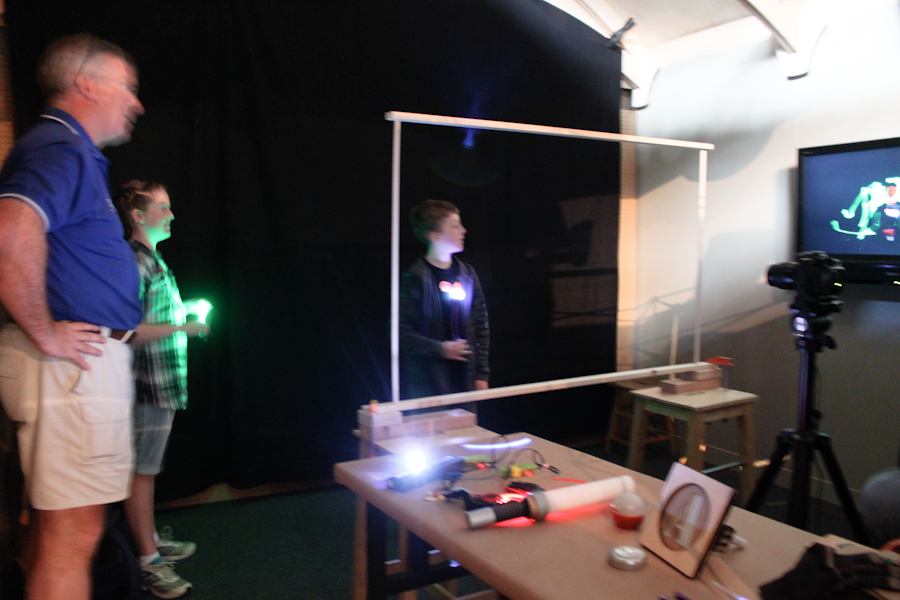
Once inside, we paid attention to a few details that add to the experience. There is a table where the possible light sources are displayed: this allows visitors that are still waiting for their turn to begin thinking about what they'll do not just by observing, but also by tinkering right away with some of the materials.
Also, the camera is directly connected to the monitor on the wall, so that immediately after the light painting, visitors can see what they just did. This feedback is crucial, in that it allows to check expectations against results, and iterate the next version of their experimentation.

Finally, we built a simple wooden frame that immediately lets participants know where they can draw: this allows them to concentrate on what to draw and the creative aspects of experimentation, without having to blindly guess whether they are in the picture or not. It would be easy to skip this step, and I doubt that many of our visitors were even consciously aware of the frame's presence and role, but I am certain it adds an essential element to the experience.
We knew that we wanted visitors to be able to take away a printout of their light painting if they wanted to, and somewhere during the prototyping phase we came up with the idea of having the photos printed as a postcard, so that visitors could mail them to themselves or their loved ones at home.
Beautiful laser-cut mailbox |
Postcards! |
Ryoko modeling the right behavior |


I knew that, even if the idea seemed cool, most visitors would not actually go through with mailing their postcard once they had left the museum, so the idea came out to have stamps ready, and a mailbox: this way people could write, stamp, and mail their postcards on the spot!
In the end, only a few visitors took advantage of that opportunity, but going through the process of problem-solving how to make postcards, and creating a workflow to go from camera, to screen, to print out, was a lesson that will come in handy in the future for sure. And this was Ryan's first real laser-cutter project: the beautiful mailbox you see was entirely made by him!

Of course we also were planning on making online galleries of all the photos taken, and wanted the visitors to be able to go online, find their own photo, and download it for their own use. We took this opportunity to prototype a couple of ideas: we made a web page that has not only slideshows of the light paintings, but also links to our website's activity page for it, and a link to a PDF document explaining how to do this at home.
We've also been thinking of ways to link our physical content in the Tinkering Studio to our content online, so I took this opportunity to make a little QR-code that links to the URL directly, so that if you have a smart phone (and these days, who doesn't?), or even a dumb phone with a camera and internet access, you can scan the code and it will take you directly to the relevant page. Not many people used it, but it was a proof of concept.
It took a lengthy post to elucidate some of the things we pay attention to when developing an activity, and I am sure there are many more that I'm forgetting. Let me just add that, if you're read this far, you must really be interested in our work!