

A few of us in the Tinkering Studio are currently reading the book, The Design of Everyday Things by Donald Norman. The idea of communication between things and humans has many implications as we design and prototype exhibits, environments and activities. It's nice to have this lens to think about as we watch museum visitors try and figure out how they expect to interact with the slightly unusual, but hopefully engaging, experiences they encounter in the workshop.

One of the main points of the first part of the book is the discussion of affordances and signifiers. Norman writes about affordances as the "possible interations between people and the environment. Some affordances are perceivable and some are not." So to give a Tinkering Studio based example, in marble machines, a peg affords supporting tracks on the peg board wall.
Norman describes signifiers as elements that "signal things, in particular what actions are possible and how they should be done." We often try to make the signifiers in the Tinkering Studio less explanatory and more suggestive so that people don't have to read a lot of text before getting started messing around with materials but have some clues to how things might work together.
 Thinking about these definitions has been helpful to me as our group has continued to refine the set of materials for the chain reaction activity in the workshop space. We want to collect interesting materials that can be used in a variety of ways. It's also helpful if the things give the visitors clues about how they might be used.
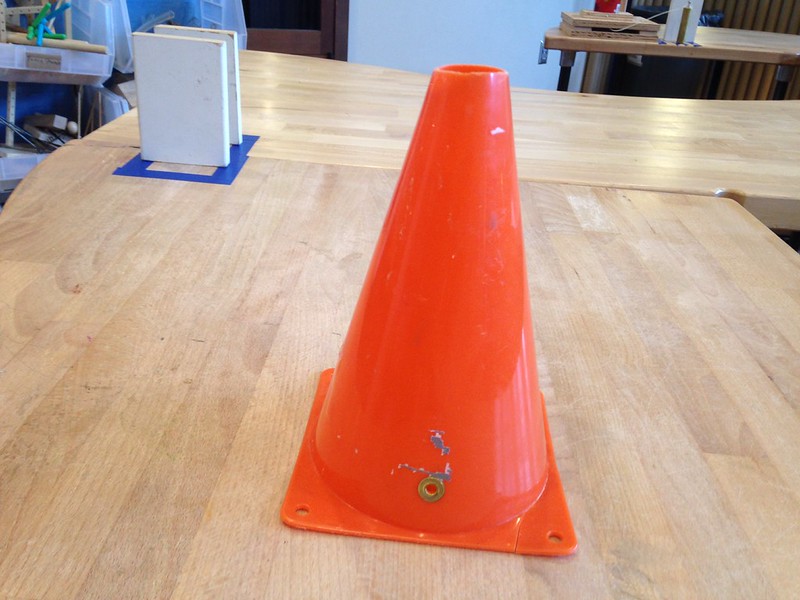
So for example, we really like this traffic cone as a chain reaction material. It can be used as a funnel, as a stand for height, as a place for a ball to rest on the small end, as a "domino" that gets knocked over, and a myriad other uses that we haven't imagined yet. It's also nice because the traffic cone is an everyday object that may add a bit of narrative to the machine and is possibly an appealing element that can become a personally meaningful contraption.

We contrasted the cone with this jacob's ladder toy which promises a lot but might not deliver as many possible interactions as part of the rube goldberg machine. It requires a precise motion to be triggered, isn't very sturdy or heavy, and after it's set off it stays in much the same position.
So in Noman's terms, this may signify a really cool element to add to the machine, but in reality, the toy might lack the multiple affordances needed to support critical thinking and problem solving in the context of the activity.
A nice thing about working on an activity over a couple of months in the Tinkering Studio, is that we get chance to really pay attention to how visitors are using the materials provided for them. This helps us reflect on our collection of materials and re-evaluate which ones are most generative for this activity. As we continue our informal book club, we hope to continue to deepen the way we think about and notice the relationship between people and materials in our space.