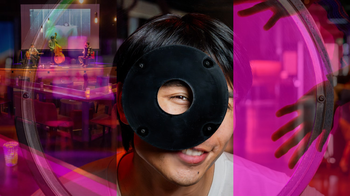
After Dark: Altered States

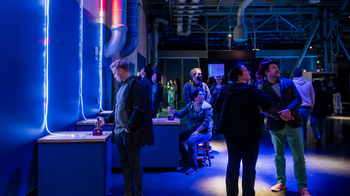
Join us for an evening of mind-expanding programs, from experimental music to psychedelic research. Immerse yourself in unusual sensory experiences with our exhibits. Listen to boundary-pushing music from Sarah Davachi, and learn about psychedelic education and harm reduction from local organizations.

After Dark Thursday Nights
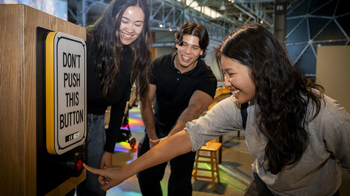
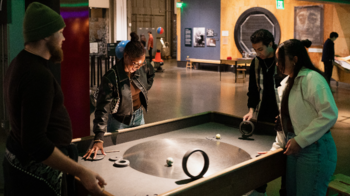
This event is part of our After Dark Thursday Nights series. Unplug and play with 650+ interactive exhibits exploring science, art, and perception.
This performance is part of our Resonance series. For more information please visit Resonance: Sarah Davachi.
With Bia Labate, PhD and Marcelo Leite, PhD
In recent years, psychedelics have exploded in popularity in mainstream culture. How can we care for the natural world that provides these substances, all while respecting cultural traditions and ensuring a just future for all who engage with them?
Hear from Dr. Bia Labate, co-founder of the Chacruna Institute for Psychedelic Plant Medicines, about the important work they’re doing in psychedelic education, outreach, and justice.
Dr. Bia Labate is a queer Brazilian anthropologist based in San Francisco. She has a PhD in social anthropology from the University of Campinas in Brazil, and her work focuses on plant medicines, drug policy, shamanism, ritual, religion, and social justice.
Marcelo Leite, PhD is a science journalist and book author based in São Paulo, Brazil. He is a columnist with Folha de S.Paulo, where he writes about psychedelics and was a science editor for a decade.
With Michael Silver
The camera is a common metaphor for human visual perception, but the comparison falls apart when we consider the rest of the brain. While our perception of the world is informed by the patterns of light entering our eyes, our conscious experience is actively constructed by the brain and impacted by our expectations and attention, making it a “controlled hallucination”:—inferences generated by the brain to literally "make sense" of the neural activity coming from the eyes.
Join Dr. Michael Silver from UC Berkeley Center for the Science of Psychedelics to learn about how research into psychedelic drugs has the potential to help us better understand these inferences, and therefore, consciousness itself.
Michael Silver is a professor at UC Berkeley's School of Optometry and Vision Science and Department of Neuroscience, and the director of the UC Berkeley Center for the Science of Psychedelics. The research goals of his laboratory are to better understand how the human brain constructs representations of the environment, and how these representations are modified by cognitive processes such as attention, expectation, and learning.
With Gül Dölen, PhD
“Critical periods” is a theory that first rose to prominence in the 1930s, when neuroscientists believed there is a finite stage in mammal brain development that enables rapid learning.
Hear from UC Berkeley's Dr. Dölen to learn about the latest discoveries on how psychedelics may unlock critical periods, and what they tell us about the therapeutic promise of these substances.
Gül Dölen is a professor and the Bob & Renee Parsons Endowed Chair in the Departments of Neuroscience and Psychology at UC Berkeley. She has won many prestigious awards for her teaching and research, and also maintains an adjunct professorship at the Johns Hopkins University School of Medicine.
With Aziz Abbatiello, Anna Whirling, and Sherbet Collective
“Do not feel lonely, the entire universe is inside you. Stop acting so small. You are the universe in ecstatic motion”—Rumi
Whirl into a different state of being and experience an ancient Sufi ceremony rooted in
the mystical tradition of the 13th century poet Rumi. Combining spinning, music, and chanting, this practice engages the body and mind to shift awareness.
No prior experience necessary; join us to experience this whirling dance meditation with guided instruction. Whether you whirl, chant, walk in quiet meditation, or simply witness, you are part of the circle.
Aziz Abbatiello was raised in an American Mevlevi family and continues to walk the path of the mystics in the Sufi tradition. He was initiated as a Semazen (Sufi whirling dancer) in 1996 and has participated in Sema ceremonies with various Sufi groups in the United States and abroad.
Anna Whirling is originally from Ukraine. At the start of the war, she moved to Turkey and later relocated to the United States. Anna has been practicing whirling since childhood and has performed on stage with various groups for over 20 years.
Sherbet Collective is a musical collective that draws on the rich sound and mystical messages of Turkish Sufi Music traditions. Like the traditional Middle Eastern beverage sherbet (or sharbat), a drink that symbolizes spiritual sweetness, nourishment, and enlightenment, the group creates timeless, soul-stirring experiences.
With Crescendo Research
Lie down. Put on headphones, and feel the music begin.
A tactile audio floor beneath you enables you to experience music through full-body vibration. Don't miss this rare opportunity to experience a new level of deep listening.
Crescendo Research aims to redefine the way we experience music and audio. With an avid love of music, and a wealth of experience in a variety of engineering disciplines, founders Ben Aldern and Erik Zaro have set out to create products that engage the senses, and deepen the connection to music in powerful new ways.
This program has limited capacity. Pick up a timed ticket in Gallery 1 to reserve your spot for this experience, or wait in the standby line. Program happens every 20 minutes.
With Tammy Cook-Endres
Why does a pair of distortion goggles mess with your aim? Come explore your eyes, visual systems, and how they interact with your motor skills. Design your own experiments with others in this interactive workshop.
Tammy Cook-Endres is an Exploratorium educator and director of the Exploratorium Leadership Fellows Program. She is passionate about crafting learning opportunities for all students that ignite a love of science.
With the PACE Explainers
Let your taste buds take a trip and experience the remarkable sensory transformation of consuming Synsepalum dulcificum, the West African “miracle berry.” The active compound in the berry, miraculin, temporarily alters taste receptors, changing how the palate experiences familiar foods.
Participants in the PACE Program (Professional Advancement and Career Exposure) are young staff aged 17–21 who gain valuable supplemental work experience in a variety of Exploratorium museum departments.
With UC Berkeley Center for the Science of Psychedelics
Join researchers from UC Berkeley’s Center for the Science of Psychedelics (BCSP), and learn about how psilocybin (also known as magic mushrooms) affects the brain. Examine the substance’s influence on our visual experience, compare brain images, and discover its potential to treat mental illnesses.
The UC Berkeley Center for the Science of Psychedelics advances psychedelic discovery for the public good. The center supports rigorous, interdisciplinary inquiry and meaningful public pathways into science, journalism, applied research and policy, and the culture and community around psychedelics.
With DanceSafe
From driving on the streets to dancing (and imbibing) at late-night parties, we all engage in behaviors that involve varying levels of risk every day. How can we reduce the risk of harm and promote health and safety? Learn about the basics of harm reduction from DanceSafe volunteers, explore the science of drug reagent testing, and grab some take-home materials on consent.
DanceSafe is a nonprofit, peer-led public health organization dedicated to harm reduction, drug education, and community care in nightlife, festival, and electronic music spaces.
With The Shulgin Foundation
Join the Shulgin Foundation to explore the incredible psychedelic contributions of Sasha and Ann Shulgin. From an unassuming 200-square-foot lab in Lafayette, California, Sasha created over 250 novel psychedelic compounds, including MDMA, while Ann pioneered therapeutic frameworks that continue to guide modern psychedelic therapy.
Take a look at some of Sasha’s alchemical work and materials, learn about special events at the Shulgin Foundation, and meet Sasha’s protegé Dr. Paul Daley at 8 p.m.
The Shulgin Foundation honors the legacy of Alexander “Sasha” Shulgin’s groundbreaking synthesis of over 150 new psychedelic compounds and Ann Shulgin’s groundbreaking work in psychedelic-assisted therapy. The foundation maintains the Shulgins' historic farm as a nexus for psychedelic education and culture, and fosters a vibrant community dedicated to inquiry, healing, and expanded consciousness.
With the Midnight Teahouse
Change your consciousness with a cup of tea and warm company. From amplified alertness to stress relief and relaxation, tea and tisane offer accessible entry points into altered states of awareness. Slow down, taste intentionally, and notice how a single sip can shift your focus, energy, and presence.
The Midnight Teahouse offers pop-up experiences of curated gongfu tea service, live music, and cozy corners.
With Sanjay Makhijani
Experience mind-bending mirrors, perplexing perspectives, and distorted visions that drive a disconnect between perception and cognition. Come explore how it feels to defy gravity and walk on the ceiling.
Sanjay Makhijani (he/they) teaches science teachers and leaders through the Exploratorium’s Teaching & Learning wing. For the 20 years prior to working at the Exploratorium, Sanjay was a public school educator in the San Francisco and San Mateo counties.
Try out a beloved Exploratorium exhibit, Hoop Nightmares, now adapted for a bigger, two-player experience. Force your visual system to adjust to a warped view of the world and turn surefire buckets into airballs. Will you find your stroke?
To dive deeper into this phenomenon, join us at the Retrain Your Brain Workshop at 7:30 and 8:30 p.m. in Classroom 2610.
With the Visitor Engagement Facilitators
Build machines that scribble with highlighters under ultraviolet light. These unpredictable creations will dance to their own choreography, leaving glowing patterns and luminescent designs in their trail.
The Visitor Engagement Facilitators are a group of Exploratorium educators who support, inspire, and empower visitors.
The Tactile Dome is a tactile sculpture that encourages visitors to use their non-visual senses to find their way. Prepare for an adventure, trust in yourself, and bring a pair of socks!
This beloved Exploratorium staple was designed by August F. Coppola in 1971. A member of the Participatory Art movement, which involved participants as part of the exhibits, Coppola believed that facilitating touch and interaction between people and art have the power to change lifestyles—even whole societies.
Please note: The Tactile Dome requires a separate ticket in addition to museum admission. Reservations are required and we strongly recommend purchasing your tickets in advance.
Upcoming Events