Guide to the 2026 Total Solar Eclipse
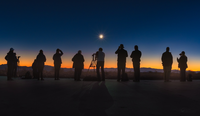
Find out where to be and what to do for the eclipse experience of a lifetime.
Be ready.
On August 12, 2026, the first total solar eclipse for mainland Europe since 1999 will be visible from parts of Russia, Greenland, Iceland, and Spain. Glimpse the full glory of the Sun’s outer atmosphere, or corona, visible only when the Sun’s disc is completely covered by the moon.

Be on the path of totality.
To witness this incredible total solar eclipse, you will need to be within the 180-mile-wide path of totality. The path will begin in remote northeastern Siberia, then pass over the Greenland ice cap, clip the western edge of Iceland, then cross the North Atlantic Ocean to northern Spain, crossing the entire peninsula from the north coast to the Mediterranean Sea. Unless you’re on that line—the path of totality—you’ll only see a partial eclipse. The difference between a total solar eclipse and a partial one is literally the difference between night and day, so get yourself into the path of totality if you can! The closer you are to the center of that path, the longer totality, the maximum point of the eclipse, will last.
The whole event will take about two hours, but totality will only last about two minutes.

Need more details? This Google Map, developed by Xavier Jubier, allows you to zoom into the eclipse path. Remember that the closer you are to the centerline (blue on the Google map) the longer totality will last.
Be (probably) not in your hometown.
Make your travel plans early as hotels and campsites usually book up months in advance! Check out the National Eclipse website for maps showing the path of totality for each country experiencing the total eclipse.

Be aware of the time.
The shadow of the moon goes through several time zones. Check the local time to ensure you don’t miss the total phase of the solar eclipse, which only lasts about two minutes. To determine the precise start time, end time, and duration of totality for your exact location on eclipse day, use this interactive eclipse map developed by timeanddate.com.
Be where the Sun shines, until it doesn’t.
Find a sunny location along the path, or the clouds will hide the Sun before the moon does. According to predictions, your best bets for clear skies are Portugal and Spain. Check out in-depth weather predictions from Eclipsophile.
Be prepared.
You will need eclipse glasses to safely view the Sun. We also highly recommend that you gather up colanders, slotted spoons, or anything else with small holes (you can poke holes in a piece of cardboard), because the eclipse will make very cool shadows. Check out our safe-viewing page for tips on building other kinds of viewers.

Be with an astronomer.
Find someone who has a telescope and knows how to use it. You can watch the eclipse with your eclipse glasses, but a telescope—with the proper, safe filter!—will make viewing the eclipse even more amazing. If you don’t have a buddy with a telescope, check at your local library or museum for special events. We will be streaming the live views from four telescopes on our website. That way, you can stand in your backyard, watch with your own eyeballs (using your eclipse glasses), and check out the close-up telescope views on your phone.

LEFT: This is an example of the close-up imagery that you can see from the telescope feed on our livestream. (Exploratorium)
RIGHT: This image shows that the sun in the sky will look relatively small, and not allow you to see any close-up details. (NASA/Aubrey Gemignani)
Be watching our livestream.
If you can’t make it to the path of totality, you can watch the livestream right here on this website (check back later for details). Why not share the fun and host an eclipse-watching party for your friends?!