Wherever the Exploratorium goes to broadcast eclipses, we help the local people learn about them by teaching the students, who in turn teach their families and friends. We want people to know what an eclipse is and, most important, how to view one safely. In Colonia, Yap, we were invited by St. Mary’s School to teach eight classes from first to eighth grades. Robyn and I accepted the invitation even though we knew that adjusting a lesson to fit students at such a range of grades would be the ultimate teaching challenge.
We came to each classroom with a bag full of hands-on demos. When we showed each class the scale model of the Earth-moon system, they all gasped at how far away the moon was from the Earth. Some turned to their science books and noticed the picture there was misleading. We showed them how they could totally eclipse a friend’s face by holding their thumb near one eye, just as the smaller moon eclipses the larger sun because it is closer to the Earth. We had them use a model of the moon to make shadows, using a large light source so they could see how the shadow got smaller as the distance between the moon and Earth increased.
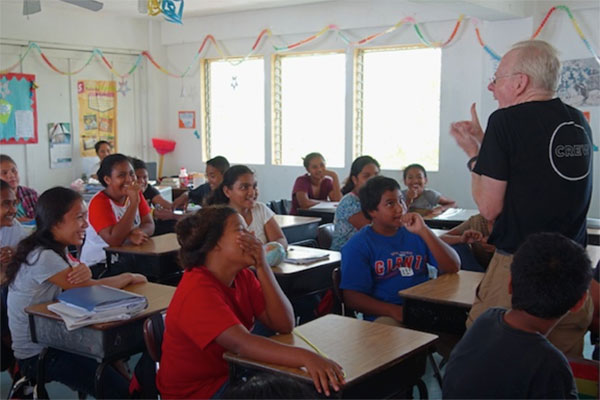
Showing fifth-grade students how to make a “total eclipse of the face” with a thumb. (photo by Exploratorium)
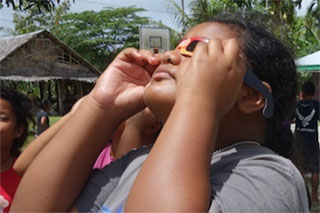
Finally, we taught them not to look at a partial eclipse with their naked eyes; that they must use the solar eclipse viewing glasses we were giving them. The students were interested and asked great questions. We laughed together as we worked together.
Over the next few days, wherever I went in Yap, children waved at me and said hello. My tour guide mentioned that his fifth-grade son told him about the class we taught. When I heard this, I smiled, because I knew that my plot to infect Yap with a deeper understanding of eclipses was working.
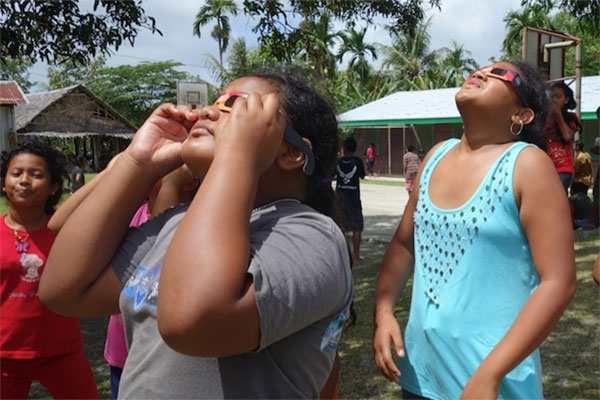
Yap students practice safe sun-viewing with solar eclipse glasses. (photo by Exploratorium)
For more eclipse information and to watch the live broadcast, visit our website.