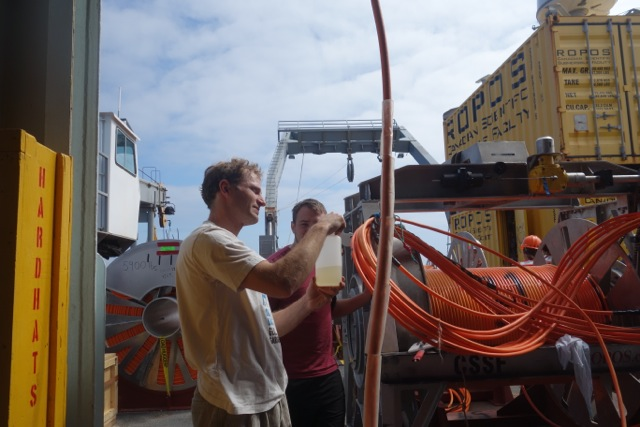
9 PM Aboard the Thomas G. Thompson
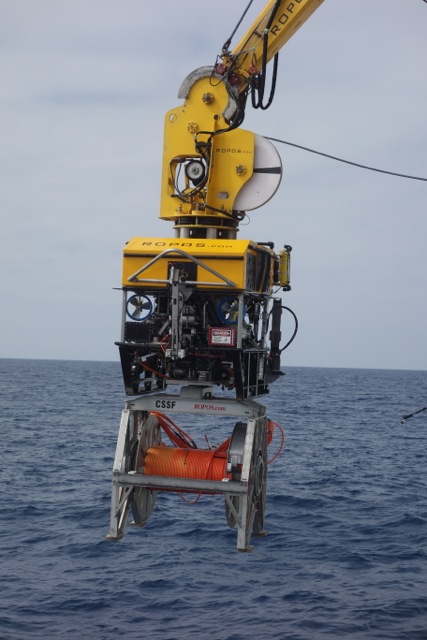 Today, it was all about the cables that deliver power and data to the ocean observatory’s secondary nodes at the Axial volcano. As anyone with an old house knows, wiring can be a troublesome thing and you definitely don’t want to take any chances with it. Earlier this morning, the ROV ROPOS attached a large spool of bright orange cable to its belly and set out to descend almost a mile to the sea floor to connect to the equipment waiting on the bottom and lay the cable. As I watched from the back of the ROPOS control room, the shift supervisor asked to zoom the camera in on the cable loops for a closer look. He didn’t like what he saw. The normally plump, round “oily” cable was flattened, indicating that it might be leaking oil and exposing the wiring inside to the corrosive seawater outside. Rather than take a chance that it would fail in the future, the team of scientists and engineers onboard decided to bring the spool back up for a closer look and some testing of the cable.
A major activity of Visions 13 expedition this summer is to lay extension cables for the Regional Scale Network of the Ocean Observatories Initiative. In total, this network of instruments, cameras, and interactive experiments will be connected to shore by 900 km (560 miles) of backbone cable. This is no ordinary cable: it can carry up to 200 kilowatts of power and up to 240 gigabits of data a second. It’s rugged as well, built to endure a long trip to the seafloor where it’s exposed to corrosive seawater and pressures up to 4000 pounds per square inch. This is the true infrastructure that will make interactive, 24/7 oceanography possible. To be sure, the instruments that plug into it are state-of-the art. But as chief scientist John Delaney says, the young scientists of today will dream up new instruments and experiments in the future and that infrastructure will be there for the 30-year lifetime of the cabled observatory.
Laying cable on the ocean floor has a long and storied history, beginning in 1850 with a telegraph cable between England and France. The first audacious attempt to wire Europe and North America with a trans-Atlantic communications cable was dreamt up by Massachusetts paper magnate Cyrus W. Field. In 1857, 2,500 miles of cable was coiled into drums and loaded aboard two sailing vessels each loaded with 1500 tons weight. The heavy cable kept breaking on route, even as engineers tried repairing it as was being spooled across the ship deck. But after much frustration, they finally succeeded in joining the two continents and the first telegraph was sent from Queen Victoria to President James Buchanan on August 16, 1858. Alas, the cable began degrading and the connection only lasted for two weeks. It took another eight years before the next, more successful cable was laid and it persisted.
For today, the cable coiled on the Thompson’s deck will no doubt fair much better than Cyrus Field’s first submarine telegraph cable. The return trip to the surface proved that the oily cable didn’t contain as much oil as it should so the engineers drained it and will perform pressure testing later to make sure there are no leaks. If it holds, they plan to refill it with a special silicon oil, seal the cable ends and return it again to the sea floor to connect it to a seismometer that will rest on the Axial seamount until the next volcano. Cyrus Field would be proud.
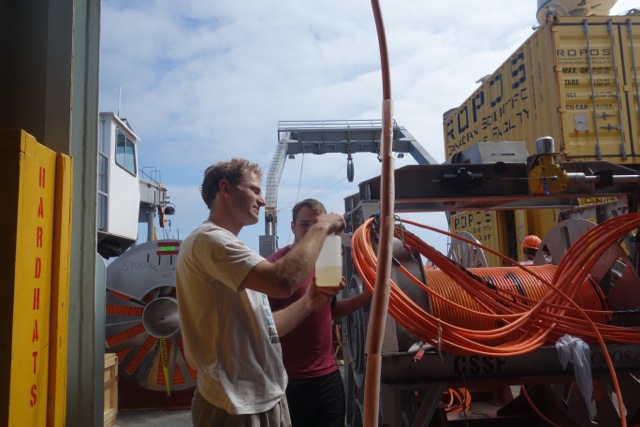
Co-chief scientist Giora Proskurowski checks the oil recovered from cable.