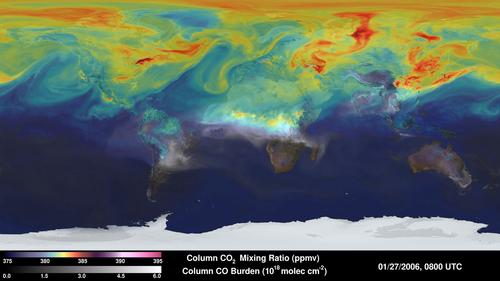
photo credit: NASA’s Global Modeling and Assimilation Office
Ordinarily I wouldn’t get up early on a Saturday and rush to a symposium about climate change. Like a lot of people, I often feel like I’ve heard more than enough about this problem—how huge it is, how bad things are going to get in the future, and how the world’s governments can’t ever agree to cut carbon dioxide emissions (as we know we should).
But last Saturday at the AAAS meeting in San Jose, I was drawn to a session called “Going Negative: Removing Carbon Dioxide from the Atmosphere.”
Instead of gloom and doom or finger-wagging sermons to cut emissions (or else!), maybe I’d hear some new ideas and solutions. Maybe someone’s developed a technological poisoned spear that will slay the evil ogre of climate change.
And I did hear about a wide range of technologies that could one day suck billions of tons of carbon dioxide (CO2) from the atmosphere.
The ideas (described in detail below) included: growing millions of acres of switchgrass, grinding up alkaline rocks and chemically reacting them with CO2, building huge arrays of fans to scrub CO2 from the air, and dumping iron into the ocean to grow more plant-like plankton.
Unfortunately, the speakers mostly agreed that these so-called “climate interventions” make sense only if you’re also going to cut carbon emissions.
Sucking CO2 out of the atmosphere while simultaneously dumping more in at full tilt (by burning fossil fuels) would be like bailing out a leaking boat.
“If you’re looking for a quick little fix, it just isn’t there,” said Ken Caldeira, an atmospheric scientist at Carnegie Institution for Science. “The best thing to do is to build an energy system that doesn’t put CO2 into the atmosphere in first place.”
So much for that poisoned spear.
Still, the researchers agreed that it’s important to invest now in technologies to absorb CO2. If we can do that and cut emissions, there’s hope we can turn things around.
“The really big cost is delay,” said Jim Edmonds of the Joint Global Change Research Institute. “Delay greatly increases the cost of all these approaches,” he said.
Listed below are five of the technologies for climate intervention discussed at the session, and in a new report from the National Research Council.
The only idea I didn’t include is changing the atmosphere so it reflects sunlight back into space. The experts generally agree that’s a crazy idea.
Listed from greatest to least amount of carbon absorption possible by the year 2100:
1. Direct Air Capture and Sequestering (aka chemical scrubbing)
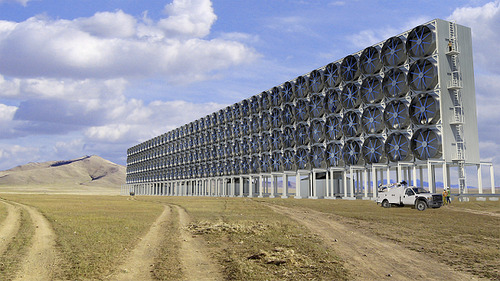
photo credit: Carbon Engineering
An array of fans draws air into a chamber where CO2 reacts with a liquid solution of an alkaline chemical, such as potassium hydroxide. Further reactions generate highly concentrated CO2 gas, which gets pumped underground and turned into stable, carbon-bearing rock.
Would it work? Maybe; demonstration projects are in progress.
How much CO2 could it remove by 2100? ~1,000 billion tons
Cost per ton removed: $400–$1,000
Advantages: Huge carbon absorption potential; capture can be done anywhere.
Drawbacks: Expensive as currently designed; uses lots of energy.
2. Bioenergy with Carbon Capture and Sequestering
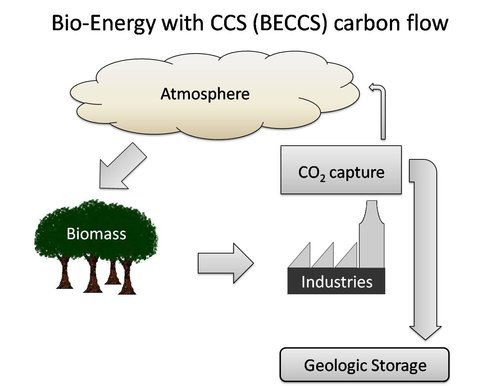
Plants such as switchgrass are cultivated, and suck carbon out of the atmosphere as they grow. The harvested plants are processed to yield energy and CO2 gas. The CO2 is pumped underground where it reacts with minerals to form stable, carbon-bearing rock.
Would it work? Yes, at some scale; possible barriers to very large-scale deployment.
How much CO2 could it remove by 2100? 100–1,000 billion tons
Cost per ton removed: ~$100
Advantages: Huge carbon absorption potential; generates energy in the process.
Drawbacks: Expanding to full potential would require up to a billion acres of cropland; large water and fertilizer requirements.
3. Ocean Iron Fertilization

photo credit: NASA
Dumping iron into the ocean boosts the growth of phytoplankton, tiny creatures that absorb CO2, as plants do. Unfortunately, this process could harm marine food webs in many ways.
Would it work? Probably, though more research is needed.
How much CO2 could it remove by 2100? 90–300 billion tons
Cost per ton removed: $400
Advantages: Some testing completed.
Drawbacks: Significant damage to marine ecosystems likely.
4. Forest Restoration and Low-Till Agriculture
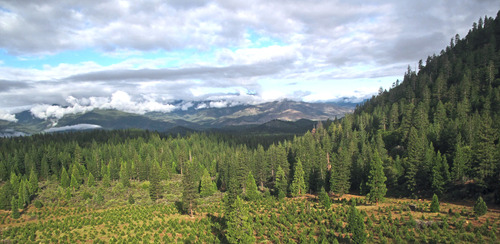
Two low-tech ideas: First, replanting previously cut forests could provide natural carbon absorption via photosynthesis. Second, because tilling the soil releases CO2, the use of alternative tools such as seed drills for planting would keep more carbon in the ground.
Would they work? Yes; these are low-tech approaches.
How much CO2 could they remove by 2100? 100 billion tons
Cost per ton removed: $1–$100
Advantages: Technology ready to go; cheapest option available.
Drawbacks: Reforestation competes with farms that produce food.
5. Enhanced Weathering
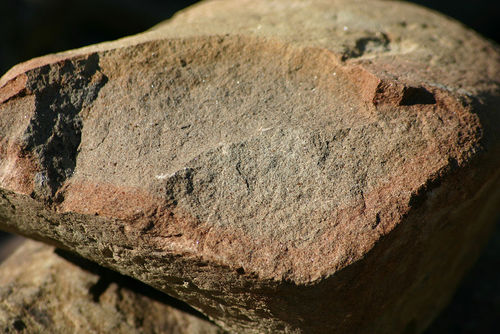
Involves crushing rock containing silicon-bearing minerals—olivine, for example—which naturally react with CO2. Such minerals could either be combined with CO2 in a reactor on land, or spread over the ocean where they would react with CO2 in the water.
Would it work? Limited testing so far, but plausible.
How much CO2 could it remove by 2100? ~100 billion tons
Cost per ton removed: $50–$100 (ocean), $20–$1,000 (land)
Advantages: Might prove relatively cheap.
Drawbacks: Ocean approach might harm marine life; scaling up could be difficult.