August 12, 2014 Turnieffe Reef, Belize
I’m sitting in the lounge of the Exploration Vessel Nautilus listening to the control room chatter and watching the video feeds from the ship’s two ROVs, Hercules and Argus, as they explore the sea floor off the coast of Belize (you can follow along on expeditions as well on the Nautilus Live website). It’s hurricane season in the Caribbean, but thankfully the weather has been fair and balmy and the sea calm. We’ve been on a mission to map and explore the deep parts of the Meso-American reef, the second largest coral reef system in the world after Australia’s Great Barrier Reef. The depths here have never been explored before this expedition and hopes were high that we’d find a lot of deep-water coral communities (and maybe a ship wreck or two).
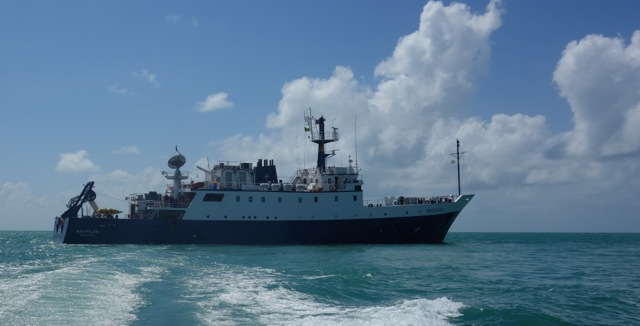
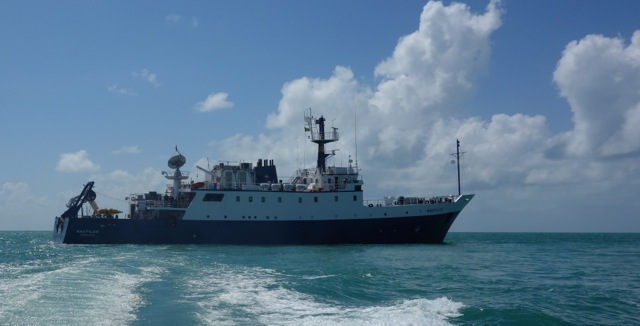
The E/V Nautilus on the Meso-American Reef off Belize.
But what’s abundant in the sun-lit surface waters off the central American country of Belize seems to be rare in the dark depths and we haven’t come across as many coral communities as hoped. That’s due in large part, according to scientists on board the ship, because of a lack of hard surfaces for the corals to settle on and grow. Unlike shallow-water coral which host an algae garden in their bodies to help nourish them, deep sea corals must capture food that streams past their tentacles. That means they need to cling to rock, not sediment, to keep from getting blown away in the current. Unfortunately, sediment is what we’ve been seeing a lot of, covering the bottom and most of the rocks we see as Hercules (or “Herc”) motors from target to target along the muddy sea bottom.
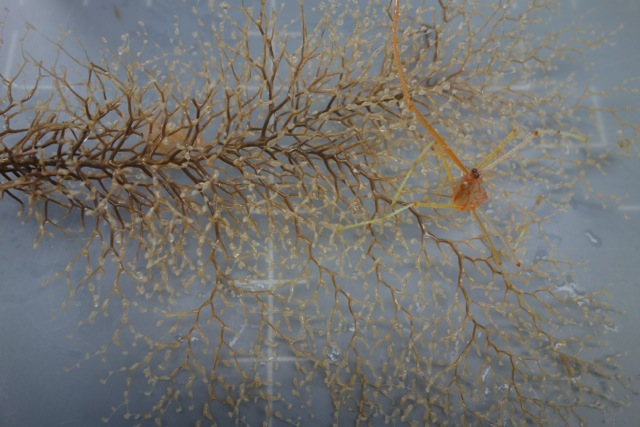
Deep sea coral with shrimp still clinging to its branches.
That doesn’t mean this expedition has been a bust. The chief scientist on the cruise, NOAA’s Peter Entnoyer, has been having the ROV pilot grab samples of corals, sea urchins, crinoids (related to sea stars), sponges, and some small crabs and squat lobster clinging to the larger invertebrates. It’s a tricky task for the pilot, who controls a joystick sending commands through a fiber-optic cable to manipulate the Herc’s arms which are charmingly named Predator and Mongo. For some of more delicate critters like the lemon-yellow tentacled creature we spied earlier today, the pilot uses a slurper tool, but that proved a bit too forceful for the gelatinous snail and I fear it’ll be bits and pieces when Peter pulls it out of the ROV sample box.
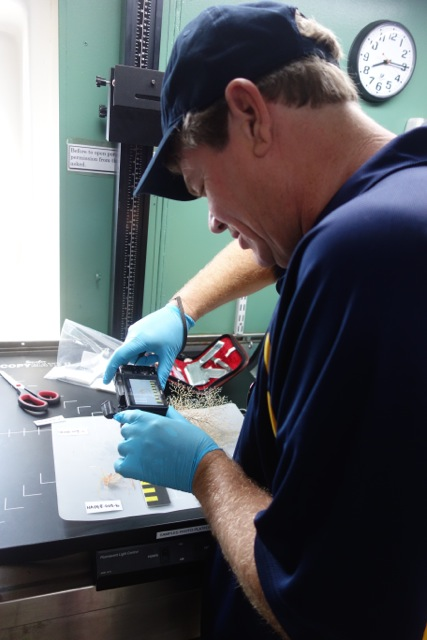
Peter Etnoyer processing samples in the wet lab.
We found out later that what looked underwater like a nudibranch (a kind of shellless, fringed snail), looked more like a worm when it came up sans the yellow tentacles. It’ll take experts back on shore time to determine what this organism really is as none of the scientists who tuned in had ever seen anything like it.
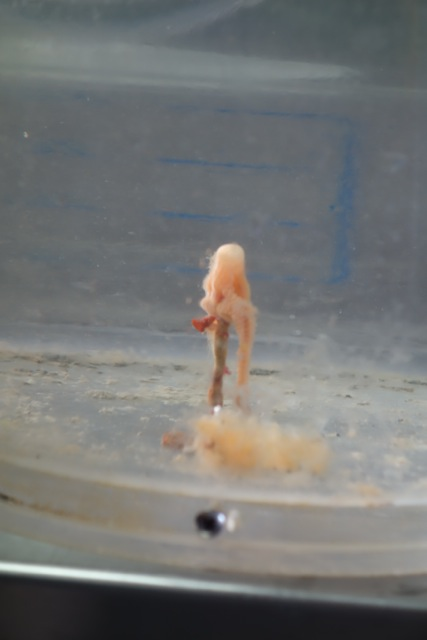
This unknown deep sea organism had bright yellow fringes that were lost during collection.
As soon as Herc comes back on deck, the invertebrates are removed from the boxes with forceps and brought into the lab. After a sample is snipped off and placed in fixative for later genetic analysis, the organism is laid out on a table to measure and photograph. The other night, a crynoid collected 500 meters below the surface was still waving its arms around when placed on the lab table to the amazement of those of us gathered in the ship’s wet lab. After the biologists here have finished examining and logging the samples, they’ll be placed in bags with alcohol for shipment to Harvard’s Museum of Comparative Anatomy and other labs around the country. Experts “on the beach” will study the corals and other invertebrates and do genetic typing to determine whether any are new, undiscovered species. Peter thinks this is a good possibility since deep-sea corals are little studied and specimens have never been gathered from this part of the deep Caribbean before. That would be a thrill for me, having seen first-hand the discovery as it happened.