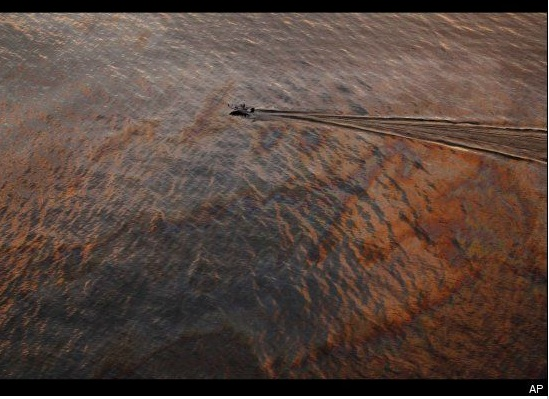
 Now that the Deep Horizon oil well has been capped and crude oil is no longer gushing into the Gulf of Mexico, NOAA and the ocean science community have been working to assess the damage. In particular, there’s a question about where all that crude has gone now that most of the oil slicks on the surface have disappeared.
NOAA issued what some scientists characterize as an over-optimistic report that most of the 4.9 million gallons of oil have been burned, skimmed, recovered from the wellhead or dispersed and is in the process of being degraded or consumed by oil-eating microbes. In the peer-reviewed report, issued in early August, the administration estimates that only 25% of the original spill remains in gulf waters. In some of their earlier reports on flow rate, NOAA was criticized for not “showing their math,” in this report they showed how the calculations were made. Here’s what they say happened to the oil:

A couple of days ago, scientists from the University of Georgia issued their own report estimating that only 10-30% of the oil was recovered or degraded and that 70-90% of the original spill remains a threat to the ecosystem. They make the point that dispersed oil (i.e. oil that has been dissolved or broken up into droplets) is still in the gulf and could harm the environment for years to come. Their report consists mostly of analysis of the governments estimates, pointing out the uncertainties and providing their own more pessimistic estimates of how much (or little, as the case may be) oil has evaporated, been consumed by microbes, and collected in marshes. They also point out the need for more sampling programs and increased monitoring of the Gulf waters, which NOAA has also announced they will implement.
So, who’s right? The Wall Street Journal favors the Georgia scientists, the New York Times green blog credits the NOAA study as peer reviewed and more credible. But this is a rapidly evolving situation and an article in today’s New York Times reports the discovery by Woods Hole scientists in June of a large plume of oil that doesn’t appear to be degrading rapidly. We probably won’t know for awhile what the true impact will be and it could be that both groups are “wrong” (i.e. their initial estimates are different from later analysis) and that the remaining oil in the gulf is somewhere in the middle of these two estimates. Like it or not, that is the nature of science, not to always pinpoint the definitive truth, but to give their best estimates based on available evidence and to continue monitoring and sampling to refine and sometimes correct initial observations and findings.
Given that people’s livelihoods and the Gulf ecosystems are at risk, it was important for NOAA to not wait until scientific consensus was reached before issuing their report and I would frankly be more worried about the estimates if there was no scientific debate about them. It is the nature of science to be a self-correcting enterprise and the nature of scientists to be skeptical, question the evidence and continue to seek answers. Because the Gulf is such a complex system, because a deep-water spill of this magnitude is extremely rare and therefore not well studied, lots of scientists will remain engaged with these questions for years to come. Their continued efforts should help society understand the environmental impacts of oil spills, decide what risks are acceptable and which are not, and whether deep-water drilling activities should continue and, if so, how they should be regulated.