1 PM aboard the Thomas G Thompson

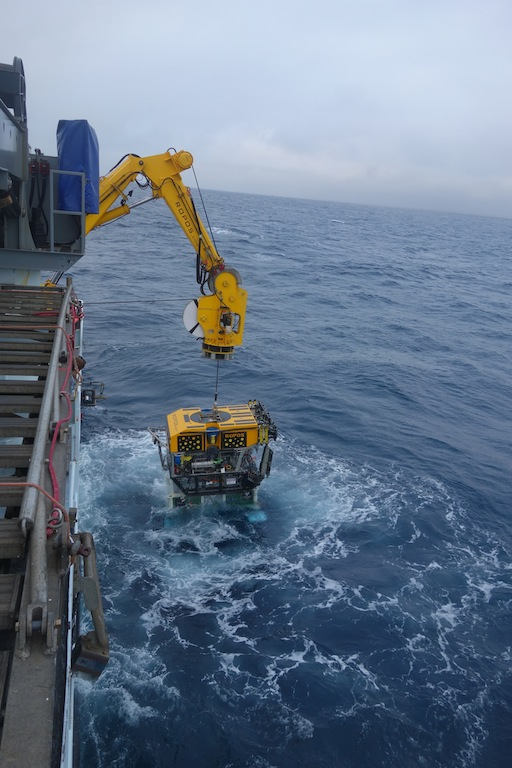
ROPOS being lifted back onboard TGT
History is being made on the Visions 13 expedition, but it sometimes comes in fits and starts. We’ve been holding here on the edge of the continental shelf 3000 meters (6000 feet) below us waiting to launch the ROV ROPOS. The crew first tried this morning around 6 AM, with the aim of placing a one-ton “medium power junction box” on the study site known as Slope Base. Everything was going smoothly until the combined load of the ROV and junction box was being lowered into the water and a swell lifted the ship, pulling the ROV load down relative to the ship and straining the cable. Called a “snap-load” this isn’t safe for the ROV or the junction box, so the crane operator lifted the ROV safely back onto the ship’s deck to wait for the weather to cooperate or come back another day.
Such is the nature of ocean research. You never want to take unnecessary risk with equipment or crew so we wait until conditions improve or change the plan. In the meantime, back to history.
The chief scientist of the expedition, John Delaney, explained the reasoning for a cabled ocean observatory in a two-hour conversation he had with graduate students yesterday. Here’s the condensed version (you can watch John’s Ted talk for a more complete version):
- The oceans are the planet’s life support system
- The oceans are complex and their geological, chemical and biological systems are little known
- If you want to understand how the entire Earth system operates, you need to monitor the ocean with a seafloor observatory that operates continuously and share the data with everyone.
John also points out that the need to understand Earth’s complex and interacting systems is urgent. The oceans and the planet are undergoing rapid environmental change that will affect the lives of billions of Earth’s inhabitants. In order to adapt to and mitigate these changes, we need to understand why and how our life support system is changing and what the future might bring. That is why the National Science Foundation, and by extension all us taxpayers, are investing more than $385 million in funding the Ocean Observatories Initiative of which the Visions 13 expedition is a part.