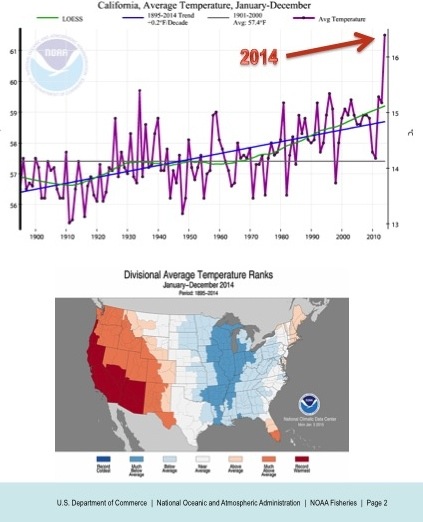
 We’ve just gone through the driest January in recorded history in San Francisco. That record is likely to stand, since we didn’t get a drop of rain last month and you can’t get any drier than that. Of course, a complete lack of rainfall is bad news for the ongoing multi-year drought, but it’s not the only weird weather we experienced. I went to a talk recently by Nate Mantua, a climatologist for NOAA, based at the Southwest Fisheries Service Center in Santa Cruz. Nate showed data records (right) that put 2014 as the hottest it’s been in more than a century. All but a few days last year were each warmer than the average daily temperature in nearly all locations in the state.
It should be said that this unusual warmth was experienced throughout the southwest, centered in California, although large swaths of the midwest and east coast had cooler than normal temperatures last year.
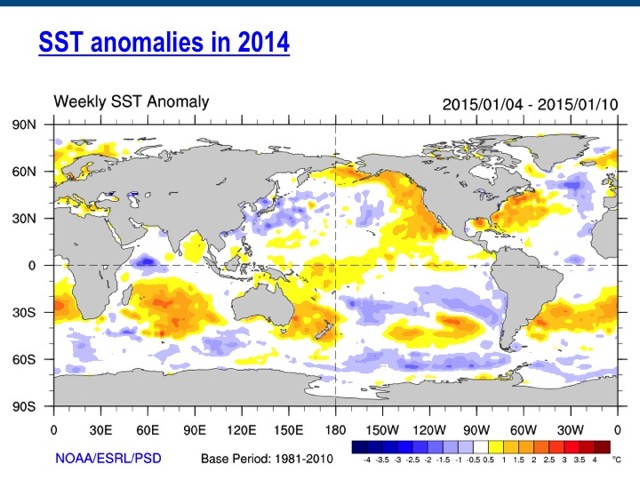
So what’s going on? Certainly global warming, or as some people call it “global weirding”, is disrupting our climate patterns. But it wasn’t just the land, the Pacific Ocean also behaved strangely last year.
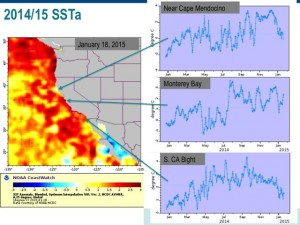
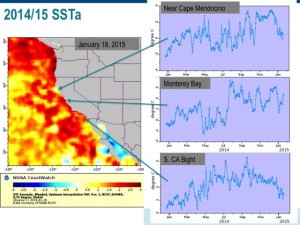
The Pacific has a strong influence over weather, especially for those who live near the coast. In the late spring and early summer, ocean temperatures are generally cool and that cool water can generate fog and chill winds that provide natural air conditioning to the Bay Area. But last spring, sea surface temperatures from Baja California to Alaska were one to two degrees warmer than typical (there were days last year when the water was nearly warm enough in Monterey and San Francisco to swim or surf without a wetsuit). Whether the warming over the last year is a sign of larger patterns in Pacific Ocean temperatures remains to be seen, but scientists are keeping an eye on it.
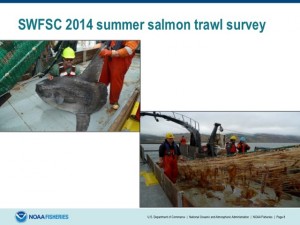
The warm water brought with it a myriad of tropical marine species off the coast, including mola mola (aka sunfish) and plenty of jellies caught in the summer research cruise conducted by NOAA’s Southwest Fisheries Science Center.