
In a previous post I described a method of arranging a collection of dots in order to determine if their quanitity was prime. This webpage does something similar. Stephen Von Worley, extending an idea of Brent Yorgey's called Factorization Diagrams, created an animation which adds one dot after another to the screen while systematically arranging them into different patterns.

The prime quantities can be easily identified because they form simple rings. But the really interesting thing is the appearance of the non-prime numbers, the composites, which display a wild variety of different patterns. In this post, I would like to explain the process by which the dots get arranged and point out some things it reveals about the structure of the natural numbers.
To begin, consider the number thirty. If we wanted to "build" this number from the multiplication of smaller numbers, we would have several ways to do it:

We can continue this game, breaking the numbers in the equations into still smaller factors.

But at this point a couple of interesting things have happened. First, the process of factoring is now over. Every number being multiplied is prime and since primes are indivisible we cannot break these products down any further. Second, although we have arrived by different routes, we've ended up with the same collection of primes in all three of the above cases: 2 x 3 x 5 (in some order).
This process of unpacking a number into a set of primes is called prime factorization. Every number has only one factorization (5 x 3 x 2 is the only set of primes whose product is thirty) and each number's is different. You can think of the prime factors of a number as being like that number's fingerprint, unique and indelible.
For a given number of dots, the animation finds an arrangement that uses each of that number's prime factors as a visible symmetry. Thirty dots, for instance, factors into 5 x 3 x 2. So first we make a ring of five circles. We then subdivide each circle into three smaller circles. Finally, we subdivide each of those into two more circles. Zooming back out we have created an arrangement of thirty dots: pairs, clustered into triples, which are then clustered into a ring of five. 2 x 3 x 5.

It's quite mesmerizing to watch the evolving factorization diagrams. Below I have listed some interesting configurations to look out for.
Fractal powers:
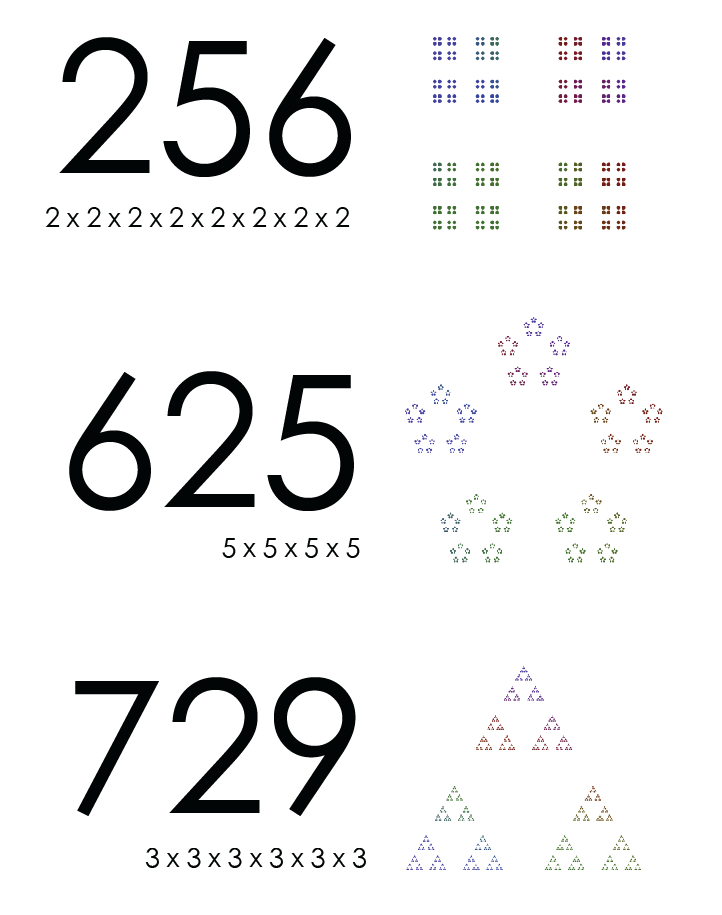
Consider a number that is a prime raised to a power (for example 256, which is 28). The process of constructing the factorization diagram will mean repeated iteration of the same procedure, over and over, at many different scales. This is a well known-way of creating fractals. Prime powers produce many familiar fractal constructions in their factorization diagrams, including Cantor dust and the Sierpinski gasket.
Twin primes:
Other than two, all prime numbers are odd. For this reason there are no consecutive primes other than two and three. The closest together that two larger primes can get still keeps them separated by at least a single even number. It turns out that "twin primes" of this sort actually occur quite often.
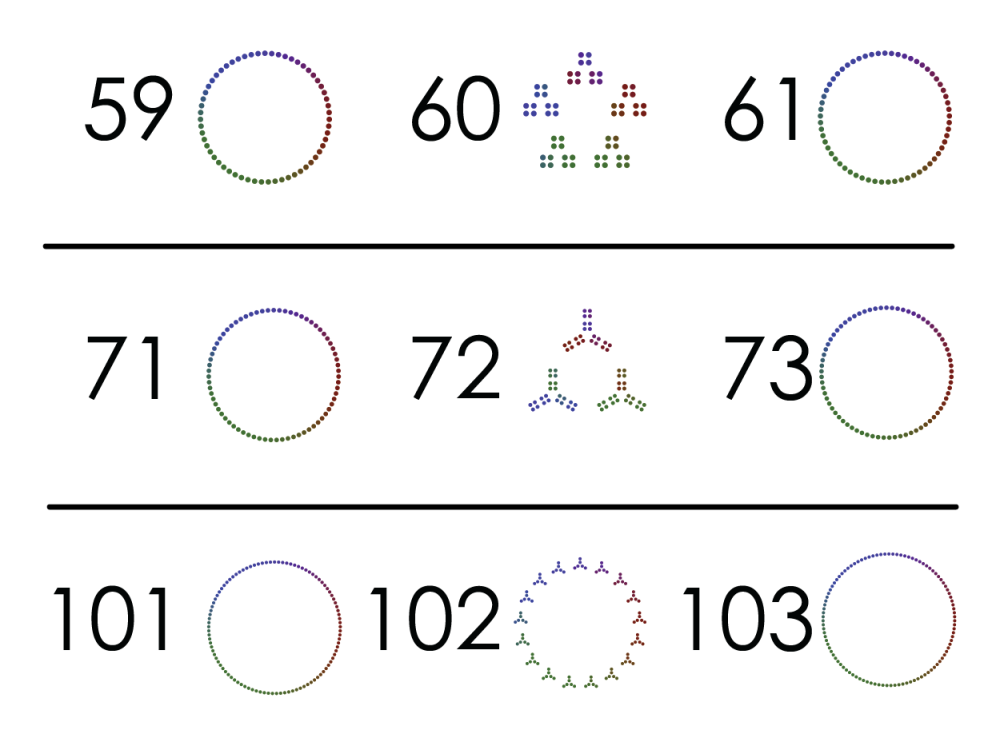
When watching the animation it's interesting, when you see a prime, to wait one beat and find out if it belongs to one of these pairs.
We know that there are an infinite number of primes. We also know that the distance from one prime to the next gets arbitrarily big: somewhere out there are two primes separated by an unbroken streak of a billion composites. The existence of these vast oceans of consecutive composite numbers makes the following conjecture all the more remarkable: we think (but have not yet been able to prove) that there are an infinite number of twin primes. Distributed computing projects continue to discover new ones: the largest presently known pair has over 200,000 digits. So while primes become rare among the large integers, when they do crop up it is often in these mysterious couples that continue to elude our understanding.
Wheels within wheels:
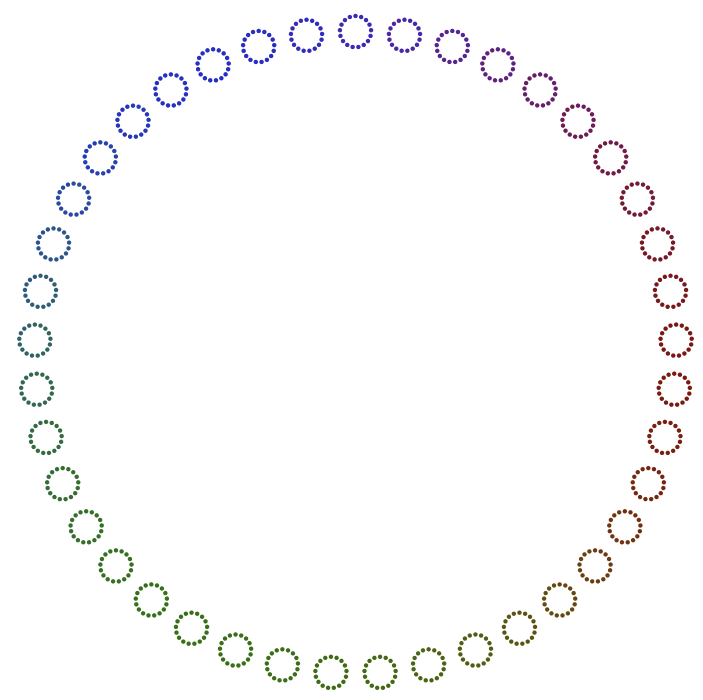
The pattern for 697 consists of 41 rings of 17 dots. This factorization is slightly more difficulat to calculate than the others we have looked at.
If someone handed you the number 697, it would take some trial and error for you to discover that its prime factors are 17 and 41. But it is very easy to multiply 17 x 41 and get 697. Although multiplication is just the reverse of factoring, it seems to be much easier to carry out. This lopsided computational effort only gets worse the bigger the prime factors you're dealing with. In fact, if two primes are big enough I can easily multiply them together and be confident that nobody, not even the fastest existing computers, would be able to figure out the original primes within my lifetime. This one-way difficulty turns out to be very useful for digital encryption techniques like RSA.
The security of such techniques depends on the notion that if a pile of dots can be arranged into a very large ring of rings then that arrangement is almost impossible to figure out. Like the twin primes conjecture this is an unproven belief, yet it is the critical presumption of modern digital security. The elusiveness of these wheel-within-wheel fingerprints is the only thing protecting your credit card number when you make an online purchase.