The following animation begins with an image of a tiny crustacean. We then zoom in on a round diatom resting on this creature's face and then, zooming in still more, we arrive at a single bacterium laying near the diatom's center.

Animated GIF created by James Tyrwhitt-Drake
These images could not have been made with an ordinary microscope. If you try to exceed about 1000x magnification with an optical microscope you'll find that the image suffers from chronic blurring. The physics of light makes some objects too small to see, a visual limit known as the diffraction barrier.
One way to achieve a higher magnification is to use something other than light. For instance, you can take a focused beam of electrons, scan the beam over the surface of an object and then study how the electrons back-scatter to determine the object's features. A scanning electron microscope of this sort is what was used in the above animation to achieve a magnification of 70,000x.
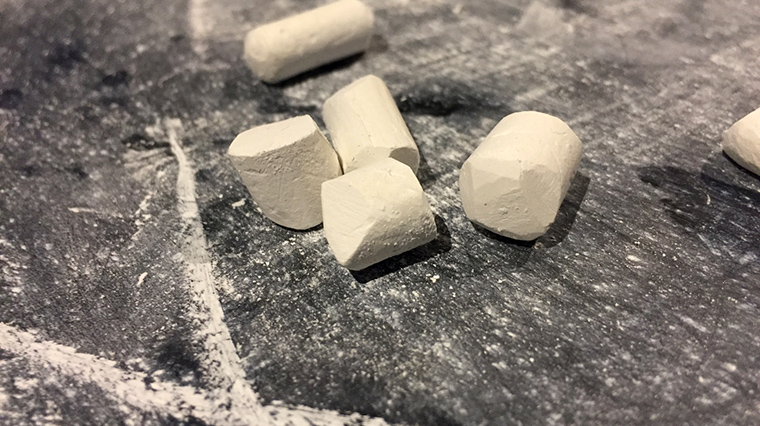
Recently, Hitachi loaned the Exploratorium a table top scanning electron microscope and we used it to take a close look at a few parts from our exhibits. Here's the the slide we prepared:
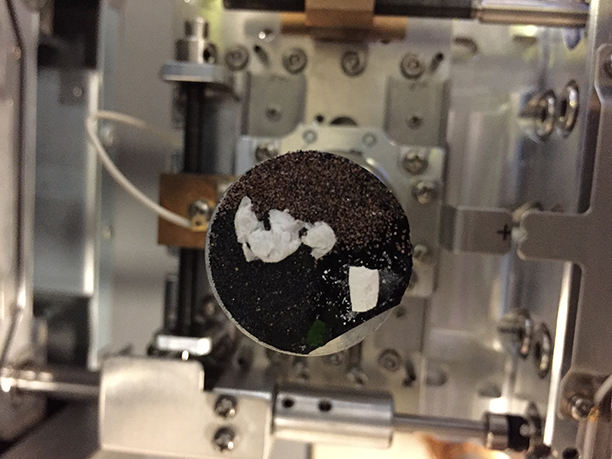
Slide containing chalk, magnetite, styrofoam, garnet sand, and a tiny piece of nasturtium.
After placing the slide in a vacuum chamber and probing the surface with electrons we were able to see details so fine that they would be impossible to image with visible light.
The first thing we looked at was chalk from an exhibit called Through the Looking Glass. In this exhibit visitors draw on a chalkboard, but they are only able to see the reflection of what they're drawing in a mirror. This reversed perspective is disorienting–writing your name now requires some strategizing and some trial and error. One thing this shows is that your hands and eyes apparently work together when writing or drawing. But the exhibit also shows how adaptable we are. Most people find that writing gets noticeably easier after a few tries.
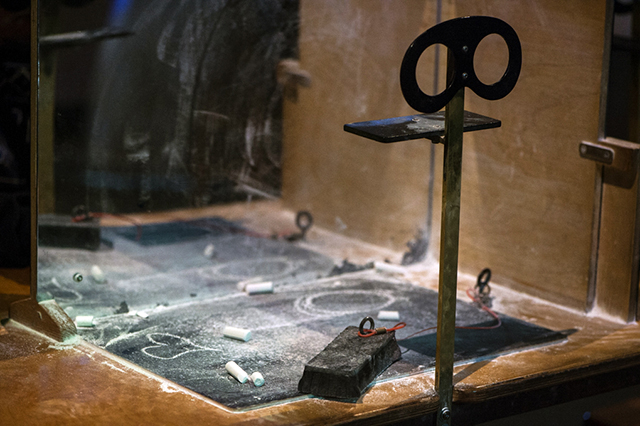
Throughout the day, museum staff members check on this exhibit and add more chalk when needed. We estimate that Through the Looking Glass consumes about 72 pieces of chalk each month.
To the eye, a piece of chalk may not look very interesting. Even at 50x magnification, this specimen seems to be just a grainy mound of pressed dust.
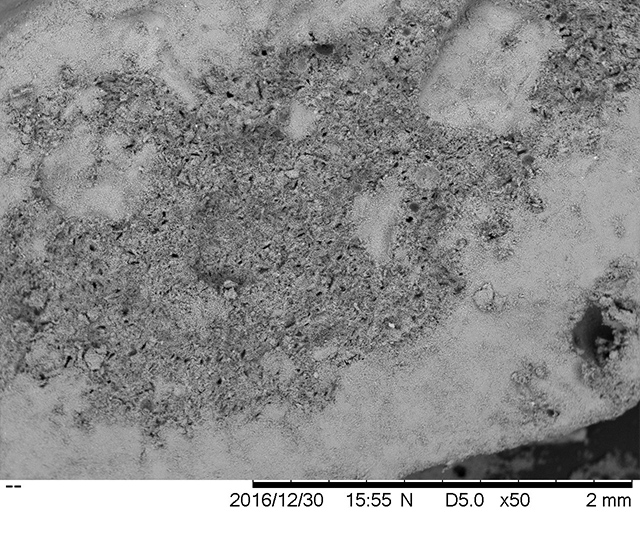
But if we zoom in a little more we suddenly find ourselves looking at what appears to be an ocean of shattered glass.

Tens of million of years ago, dying microscopic plankton rained onto the ocean floor, creating a thick layer of dead microorganisms. Over time this layer was buried and compressed by geological forces and calcite from the organisms' shells was formed into shard-like calcium carbonate sediment. Such deposits are the source of most of the world's chalk, giving us equations on blackboards, games of hopscotch and at least one Exploratorium exhibit.
