Lariat Chain

We joined forces with Community Science Workshops to design this DIY Exhibit that you can make from everyday objects for your community space. This activity is based on the Exploratorium exhibit Lariat Chain.

A round thing. With a deep groove around its edge and a hole through its middle. We used a hub from a toy car wheel and a couple of take-out food container lids.
Other things to try: two Gatorade lids glued together, a yo-yo, cardboard circles of different sizes
Something that spins. We used an electric hand mixer with only one beater installed.
Other things to try: a hobby motor. Don’t use a stand mixer, drill, or anything else with too much torque, as this can be dangerous.
A flexible loop. We used a bead necklace.
Other things to try: a dog tag chain, a jump rope with the handles removed
A stand. We made one out of scrap wood.
We also used a hot glue gun, packing tape, a utility knife, zip ties, a shelf bracket, wood screws, some wood pieces, and a screwdriver. Be very careful when cutting things with a utility knife. Watch your fingers.
Attach the round thing to the something that spins.

We slipped the shaft of the beater through the middle of the toy car wheel, making sure that the wheel was centered and lined up perpendicular to the shaft.

We then slipped on the take-out container lids (with holes cut in the middle) and applied some hot glue to hold everything together. We also covered the beater in packing tape to protect our fingers.
Be very careful when cutting things with a utility knife. Watch your fingers.
Mount the something that spins on a stand.

We built a stand out of scrap wood, with a platform and base connected by a vertical piece, all held together with wood screws and a shelf bracket.

We laid the mixer on its side on the stand and inserted some small wood pieces under it orient the wheel perpendicular to the ground.

We zip tied the mixer to the platform, cutting off the long ends of the ties with our utility knife.
Hang the flexible loop off the round thing.

We hung our bead necklace off our toy car wheel. We tested on the mixer at the lowest speed to see if our necklace moved with the wheel and stayed on. We slowly increased the speed. We tapped it with our fingers and a pencil to make interesting shapes.
Spinning objects can snag loose objects. Roll up your sleeves and tie your hair back. Don’t place your head or hands inside the loop. Be gentle!
What do you notice?
What do you wonder?
What do you want to try?
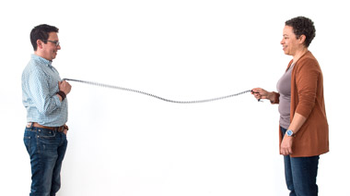
Tap the flexible loop as it spins, and you will see waves form. Some waves move in the same direction as the loop; they travel quickly. Other waves move against the loop; they travel slowly.
The same thing happens when you drop a pebble into a stream. Some of the waves made by the pebble travel faster downstream, with the current. Others that head upstream, against the current, move slower.
- If the flexible loop doesn’t move, try adding friction to the round thing; we wrapped our wheel in electrical tape.
- If the flexible loop moves too fast, try using a smaller round thing.
- If the loop jumps off, try spinning it slower or add something to your stand to guide it (you could cut a notch on the side where the loop moves upward).
- If the flexible loop doesn’t wave obviously, try a longer or heavier loop.
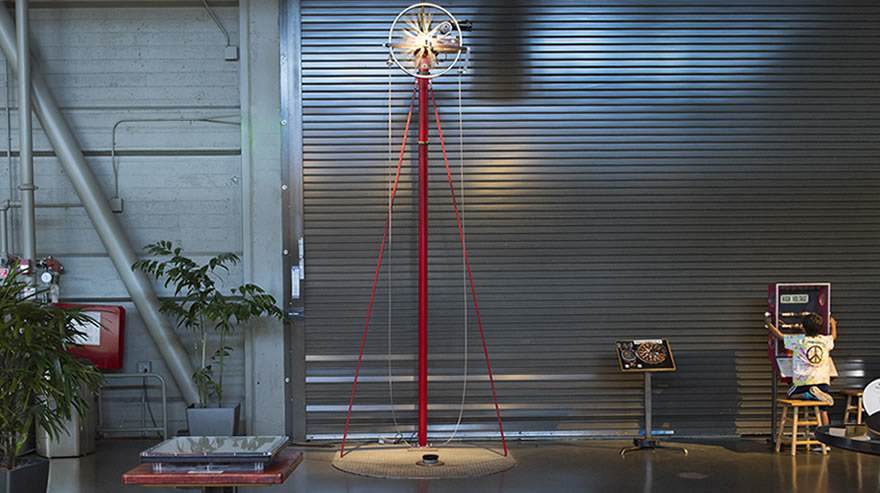
This activity is based on the Exploratorium exhibit Lariat Chain where two loops of chain are forced apart by static electricity.