Cat Whisker Interference
When laser light hits a cat’s whisker or a hair, it makes surprising patterns that demonstrate light’s wave nature. The spacing of the patterns can reveal the size of objects otherwise too small to measure.
Caution: This activity uses laser light. Be extremely careful never to allow laser light to shine directly into anyone's eyes.
- Index card
- Scissors
- Binder clip
- Tape
- A cat's whisker or a human hair (Cats naturally shed whiskers.)
- Low-power laser (5 milliwatts or less, from a reputable source)
- A block and right-angle clamp to rest the laser pointer on (or a few books)
- Tape measure or ruler
- Optional: white printer paper, clothespin (not shown)

Cut a rectangular hole in the middle of the index card to make a frame. (Click to enlarge photo.)

Tape the cat whisker to the frame, roughly in the center (click to enlarge photo below). If using a human hair, you may need to tape it to both sides.

- Clip the frame in a binder clip, and place on a solid surface (see photo above). Choose your surface so that there is a clear path to a white wall or other flat surface several meters (5 to 10 feet) away.
Prop the laser pointer on a pile of books (or use a right-angle clamp and stand, as shown below). Aim the laser beam so that the cat whisker (or human hair) splits the beam approximately in half. Direct the beam to a wall (ideally, a white matte finish wall, which makes a good screen). If such a surface is not available, tape a piece of printer paper where the beam will hit.
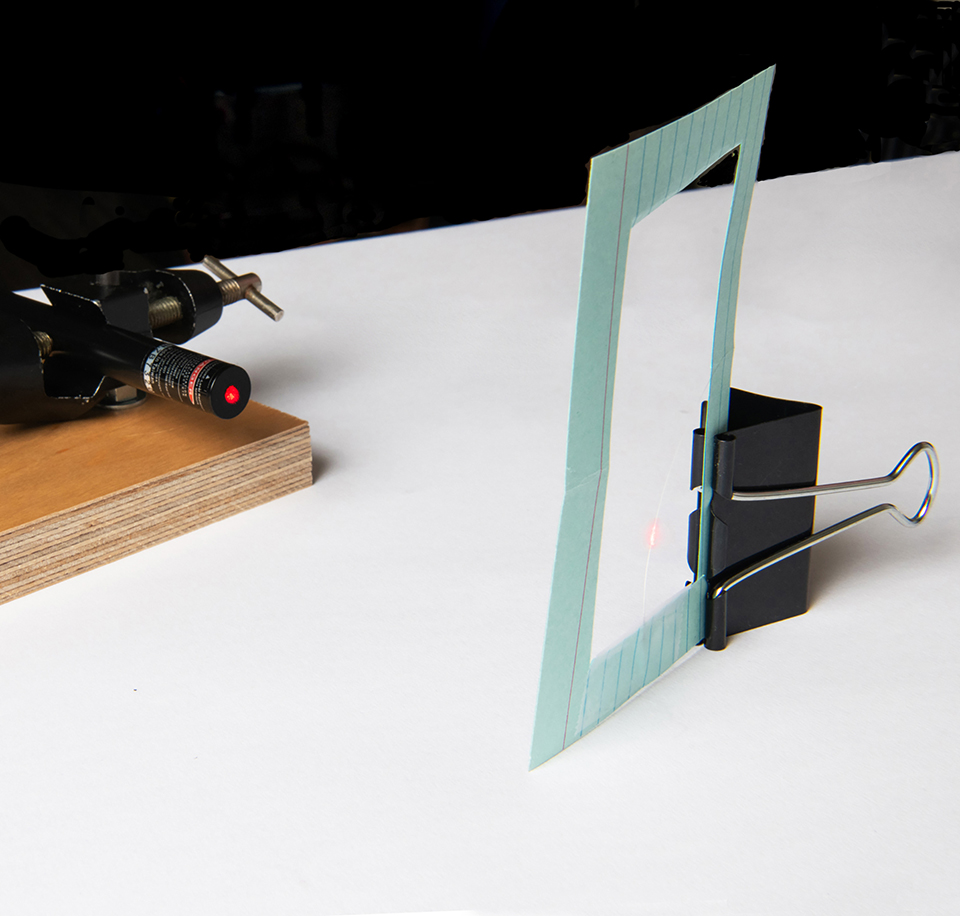
- Some laser pointers have a switch to turn them on and off, but others only have a push button. If yours has a push button, a clothespin or binder clip can help hold the button down.
Look at the beam where it hits the wall. Though you might expect to see a simple spot split in half, what you actually see is a bright center dot flanked by a series of stretched-out dark and light spots.
Use a tape measure to measure the distance from the bright center dot to the center of an adjacent dark spot on either side. If you can see more dots, you can measure the distance of several dots and divide by the number of spaces to get a more accurate result.
While keeping the distance between the whisker and the wall the same distance, aim the laser at a thinner part of the whisker. (Cat whiskers naturally taper.) Or, if you are using a human hair, try aiming the laser beam at a different spot or another, thinner hair. What happens to the spacing of the bright and dark dots?
You may want to measure the distance between the dark spots again to confirm your observation.
When light hits the cat whisker, it bends around it, or diffracts. Some light bends around the left side, while some bends around the right side, effectively creating two sources of light.
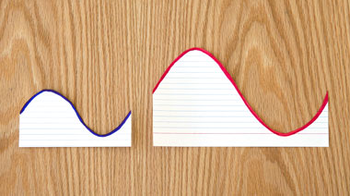
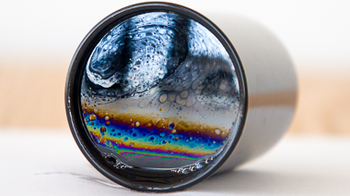
When these two light waves meet and overlap, they interfere with each other, sometimes adding together to make a bright spot, sometimes canceling each other out to make a dark spot. The resulting pattern of light and dark spots you see on the wall is called an interference pattern.
(Click to enlarge image.)
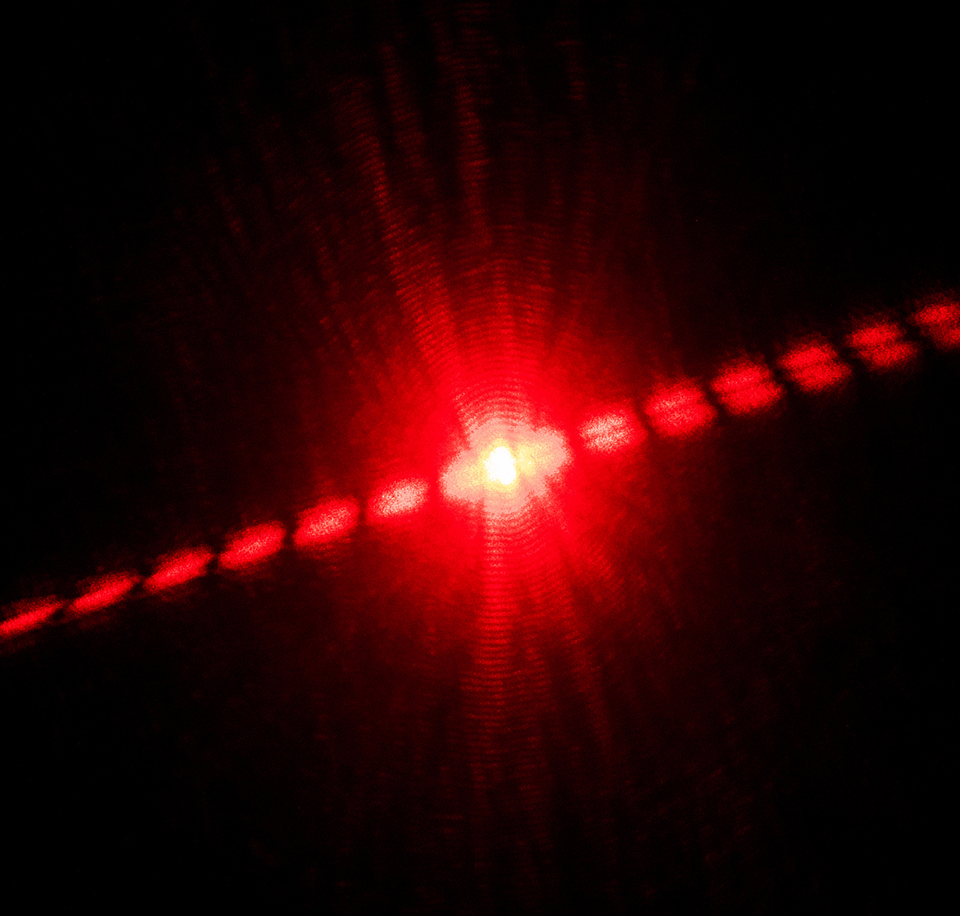
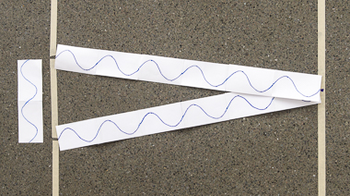
Let’s look more closely at what’s going on: The central spot is bright because it is equidistant from both sources of lights, so when the waves hit that spot, each wave hits in the same spot in the same phase of its up-down cycle. When waves hit each other in the same phase of their cycles, this is called constructive interference and the waves are reinforced. For light, that means it gets brighter.
A spot that is a little over from the central spot though is closer to one source of light than the other. If the distances are right, the crest from one source will hit the trough from the other source. When waves hit each other in the opposite phase of their cycles, this is called destructive interference and the waves are canceled, leaving a dark spot.
For more information on how light waves can interfere with each other see the Two Slit Wave Model Science Snack.
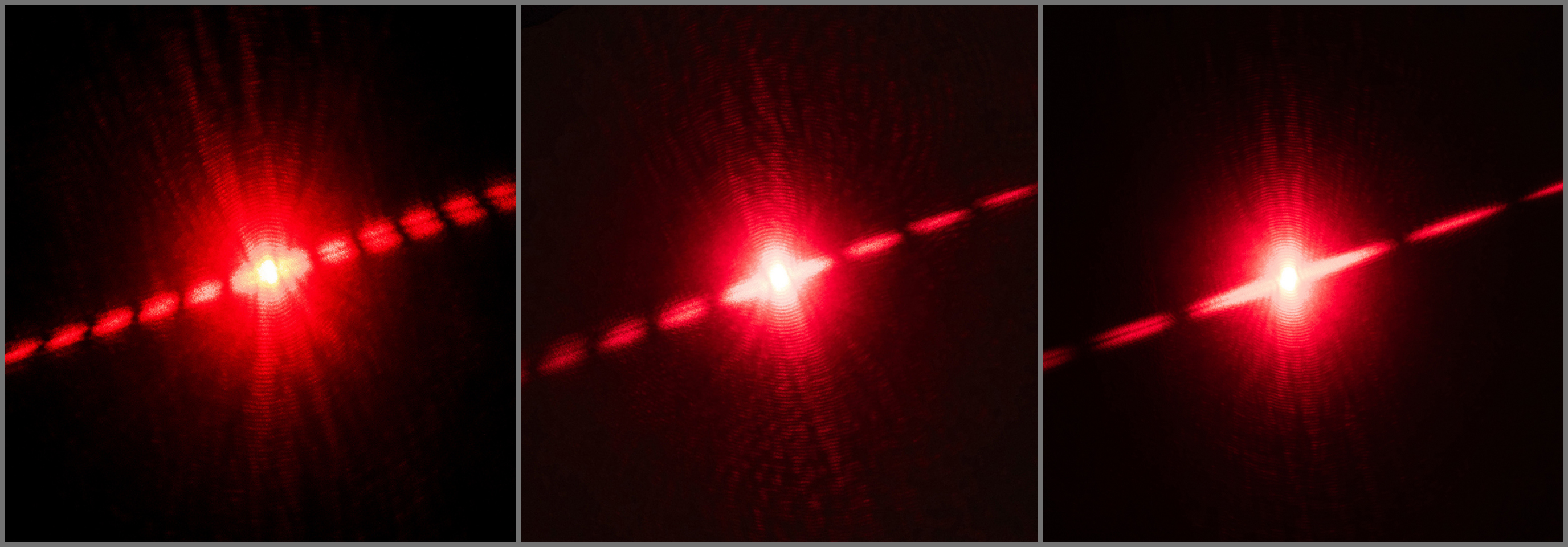
A thinner part of the whisker (or a thinner hair) creates two sources of light closer together than a thicker part. They take a greater distance to get out of sync enough to create destructive interference and leave a dark spot. Thinner objects create dark spots farther and farther apart while thicker objects create spots that are closer together. Compare the three interference patterns below created by the thickest (left) to thinnest (right) parts of the same cat whisker. (Click image to enlarge.)
You can calculate the width (W) of the object by looking at the spacing of the dark spots.
You’ll need to know the wavelength of the laser (λ), the distance from the whisker to the wall (\(d_{\text{wall}}\)), and the distance between the central bright dot and the center of the dark spot (\(d_{\text{spot}}\)). The laser’s wavelength is usually marked on the laser itself near the aperture.
$$ W = \frac{\lambda \cdot d_{\text{wall}}}{d_{\text{spot}}} $$
The trickiest bit is keeping up with the units. Changing everything to meters first might make things easier.
Cat’s whiskers are particularly useful for this activity because they start thick, but get obviously thinner, making it easier for students to see that the thinner the object the wider the spacing of the dark spots.
Students can also see some interesting properties of hair, like that hair varies widely in thickness from person to person.
In addition, they can see that straight hair tends to stay the same thickness throughout while curly hair has an oval shape so over its length its thickness changes.
This Science Snack is based upon work done in partnership with the Laser Interferometer Gravitational Wave Observatory and supported by the National Science Foundation under Grant No. PHY-2011985. Any opinions, findings, and conclusions or recommendations expressed in this material are those of the authors and do not necessarily reflect the views of the National Science Foundation.