Iridescence Prints
Use nail polish and black paper to make colorful, reflective prints that reveal the wave nature of light.
- Aluminum foil baking pan, such as a pie pan with a 9-inch diameter and 2-inch depth (the exact size is not critical)
- Black construction paper cut smaller than the baking pan
- Clear nail polish (less expensive brands often work better)
- Paper towels
- Water (not shown)
- Optional: white construction paper cut smaller than the baking pan (not shown)

None needed.
Fill the baking pan with water about an inch (2 cm) deep (click to enlarge picture below).

Submerge a piece of black construction paper under the water (click to enlarge picture below).

Open the nail polish, remove the brush applicator, and touch the tip of the brush to the surface of the water, just above the submerged paper square. You’ll see a shiny film floating on the surface (click to enlarge picture below).

Slowly lift the paper square out of the water, making sure to “catch” the overlying film on the square. Tilt the square slightly as you lift it from the water to allow water to run off. Lay the square on a paper towel to dry (click to enlarge picture below).

If you like, make several more prints this way, and lay them out to dry too.
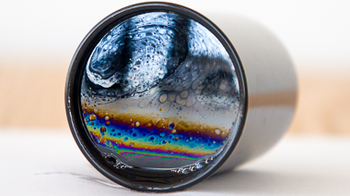
Once your prints are dry, hold them under bright light and tilt them back and forth to see an iridescent rainbow of colors.
How do you get so many amazing colors from clear nail polish? The secret is that the layer of nail polish is thin enough to cause light interference, overlapping of light waves that grow brighter and dimmer depending on their color. Here’s how it works:
The light that shines on your prints is white light, made up of many different colors or wavelengths of light—including shorter violet light waves, longer red light waves, and a rainbow of colors in between.
When these light waves hit the thin film of nail polish, some of them bounce off the top surface of the nail polish, while others enter the film and bounce off the bottom surface of the nail polish. Some go through the nail polish and get absorbed by the black paper, so we don't see them. The light waves that reflect off the top and bottom surfaces of the nail polish meet and overlap on their way to our eyes.
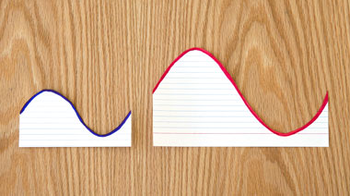
Depending on the precise thickness of the nail polish layer, certain colors will overlap so that their waves are in sync and grow bright (called constructive interference), while other colors will overlap out-of-sync and disappear (called destructive interference)—see diagram below. Slight variations in the thickness of the film cause different colors to interfere constructively or destructively, producing a rainbow pattern of reflected light.
Click to enlarge image below.

For more information about how different waves of light can interact to cause interference, check out Soap Film Interference Model Science Snack.
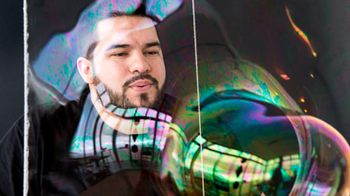
Light can interfere to produce color this way only when it interacts with transparent layers that are extremely thin—like a thin film of oil or nail polish, a soap bubble, or the microscopic scales on the wings of a morpho butterfly.
Optionally, repeat the above activity with the white construction paper. You might find it harder to see any colorful reflections.
This experiment works much better with black paper because black paper absorbs almost all of the transmitted light, that is, the light that makes it through the nail polish. When you use white paper instead, the transmitted light will get reflected back also, and drown out the smaller amount of light reflected by the top and bottom of the nail polish.
This Science Snack makes a great introduction to wave interference and the wave nature of light. The colorful prints are inexpensive and easy to take home. They also make good giveaways for school science nights.
Some fingernail polish can have fairly noxious odors. A single set-up isn’t too problematic, but if you are setting up several in one classroom, you’ll need good ventilation.
This Science Snack is based upon work done in partnership with the Laser Interferometer Gravitational Wave Observatory and supported by the National Science Foundation under Grant No. PHY-2011985. Any opinions, findings, and conclusions or recommendations expressed in this material are those of the authors and do not necessarily reflect the views of the National Science Foundation.