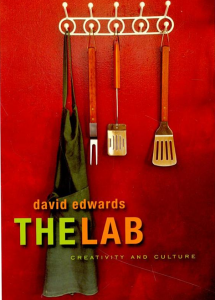
I just started reading David Edwards' book "The Lab: Creativity and Culture" (Harvard University Press, 2010). Edwards, a biomedical engineer from Harvard, founded a place in Paris called "La Laborataire." Started in 2007, this space is what Edwards calls an "artscience lab." The book describes many of these new kinds of spaces, including Ken Arnold's Wellcome Collection in London and the Science Gallery in Dublin, founded by Learning Studio friend Michael John Gorman. Ultimately these new kinds of spaces attempt to bring under one roof elements of education, cultural exhibition and production.
It's a short book, and I'll do a post for each chapter through the month of February. The first chapter, called "Dreams," describes these "artscience" labs as places where aesthetic and analytical thinking can happen side by side. "Through aesthetic thinking , we embrace uncertainty and complexity, we induce, follow intuition, and draw inspiration from images and sounds...Through analytical thinking, we simplify a complex world, reduce its challenges to resolvable problems, and pursue the logic of equations...The aesthetic process is the substance of hypothesis generation, while the analytical process is the substance of hypothesis testing." In discussing this fusing of the aesthetic and the analytical Edwards introduces what he calls an "idea translation process," a process that the new artscience lab is meant to incubate. What I like about this process is that it is iterative in nature, a process that carries "us from the contemplation of the unknown through the admission of certainty to the arrival of a new idea."
Edwards also uses the first chapter to point to the pre-cursors to La Laborataire, places like the MIT Media Lab, Ars Electronica Futurelab, and Ideo Product Development. The connections between Edwards' artscience lab and a place like the Media Lab is obvious to me. I'd like to posit that Edwards' La Laborataire represents the third wave in these kind of spaces where the aesthetic and the analytical are entwined. A place like the MIT Media Lab, founded in 1985, is the second wave. From where I sit as I write this I can see the floor of the Exploratorium, large school groups and a variety of families engaging in both aesthetic and analytical experiences. So it may be that the Exploratorium represents the first wave of these artscience labs, a place that can, as Edwards puts it, "provide interdisciplinary conditions and expressive environments that benefit creators."
Edwards' next chapter, called "Artscience Lab," will obviously go into more depth about these kinds of places. I'll have more to write about that next week, though I doubt I'll really ever quite understand why the book has a cover that suggests grilling or a bar-b-cue.
Anyhow, stay tuned.