
 Last weekend, we collaborated with five other museums around the country to try to break the world record for the longest "long-distance" chain reaction, remotely triggered from the east to the west.

The plan was to have the 'signal' travel from Museum of Life and Science in North Carolina, to Betty Brinn Children's Museum in Milwaukee, to the Science Museum of Minnesota in St Paul to The Tech in San Jose, to The Tinkering Studio, and ending with our friends at ScienceWorks in Ashland, Oregon!
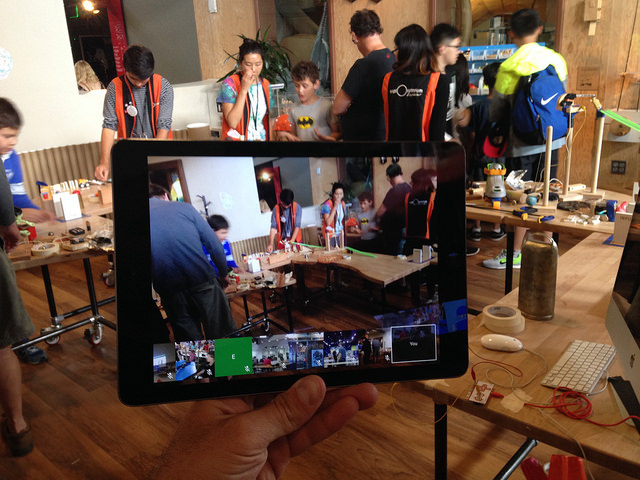
 The morning of the event, while visitors worked on the collaborative chain reaction, we set up a google hangout with all the other museums working on their Rube Goldberg machines. To better facilitate the connection, we flipped our normal workshop, setting up the chain reaction tables around the large monitor where we would be broadcasting the live event. This arrangment was something that we have been wanting to do for a long time and I felt that the environment really supported 'social scaffolding' th involving tinkerers in something much larger than their own individual projects.

It was really fun to see people all over the country working on different experiments within the framework of chain reaction at the same time. The facilitators from the different museums checked in on the progress as we coordinated the reactions.
 Additionally, I got to practice some 'long-distance' facilitation at the Tech Museum at San Jose, with my face projected up on a large screen (although I didn't realize it at the time).
 For the first table of our chain reaction, I set up a switch attached to the back of my phone in anticipation of the phone call from the Tech. It was set on vibrate so that it would slide off a roller, making the aluminum foil connect as a switch to start a slow moving motor. After the six tables made by visitors, the plan was for the machine to end with a MakeyMakey 'button press' connected to a computer set up to send a fax to Ashland, Oregon.

A celebratory crowd gathered before the set off to witness the world record attempt. The people waiting and watching in the Tinkering Studio cheered loudly as the chain reaction started in North Carolina.
We had some technical difficulties with the youtube broadcast, but you can still watch our confusion unfold on the video. There was some trouble hearing what was going on around the different sites and the video came through a little choppy on our network. Our video screen was delayed so when my phone rang, we all thought that it was too early. Everyone was waiting but it was actually the real call. Although we did finally figure it out miscommunications like that made it a little bit tricky to coordinate everything.
All in all, we had a great time and it was good motivation to go a bit further on a couple ideas that we have been thinking about for a while. Firstly, I think it would be really fun to be thinking about ways to do 'live look-ins" to other museums (especially when we are working on similar projects). This could even work in conjunction with some of the online learning we are exploring through coursera if there was a way to get people an authentic look at what happens in the TS.
Additionally I think the project ties in well with our current explorations of scratch programming, homemade switches, and other ways of connecting the physical and digital worlds. I'd like to do more research to figure out ways to more seamlessly connect switches and other interesting outputs over the web. I know there's a lot of developments in the IOT world and it would be fun to use some of these devices to help connect tinkering projects together.
And finally I'd like to consider this a practice run for our eventual 'around the world' chain reaction. We'll have to figure out some logisitcs regarding timezones and museum open hours, but I think it would be an amazing experiment to try. Much thanks to all our museum partners who helped to make an amazing rube goldberg machine and let us know if you want to get involved in the next one!