
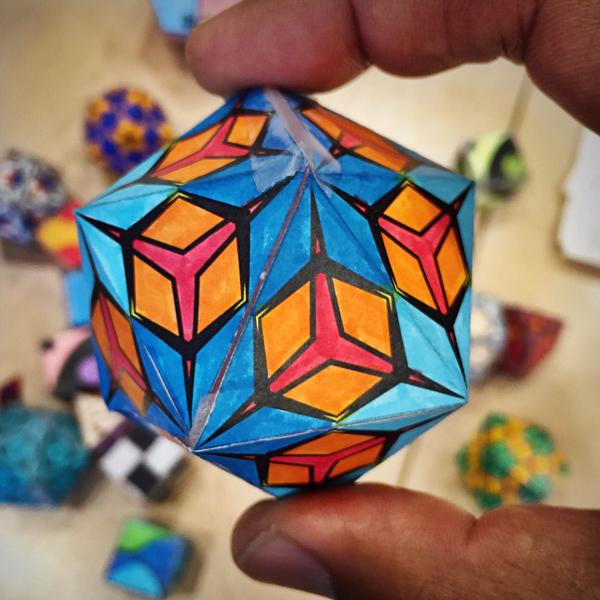
Sometimes after a long day at work, we've found that a great way to unwind is by coloring geometric patterns and folding them into three-dimensional shapes. Last Thursday night, at After Dark: Figuring, long time tinkering studio collaborator and artist-in-residence Stacy Speyer joined us to host a "Polyhedra Party" to celebrate the intricacy and beauty of these complex forms.

A few years back, Stacy worked on a temporary Exploratorium exhibit called Geometry Playground, and spent some of her time in the Learning Studio laser cutting interesting geometric shapes. Those initial prototypes started an obsession with polyhedra which has led to her creating a book and leading a campaign to spread the geometric joy through polyhedra parties. At these events participants color in 'nets' or 2D print-outs, cut out the shapes, and then fold and tape them into the three dimensional structures. It's a social and meditative experience and a fun way to "think with your hands" while exploring mathematics. 
Before the event, Stacy introduced the idea at our weekly explainer meeting. We like to make sure that our facilitators have a change to try the activities, ask questions, and get familiar with the materials and guest artists before working with the public.

Stacy brought a festive sign that really set the mood for the evening and created a welcoming environment where people could sit down and concentrate on coloring and folding for a bit. We also removed the tube wall from around the workshop to create a more open setting. 
Pretty soon we had a whole table of tinkerers working to create beautiful geometric shapes. The patterns that Stacy printed on the 'nets' emphasize different aspects of the symmetries when folded together so many people ended up coloring more than one version of the same polyhedron.

Meanwhile, our tinkerer-in-residence Lucas from NEMO in Amsterdam set up a small table to experiment with kaleidocycles, which are rotating rings made of tetrahedra that can be folded and rotated to make a interesting moving shape. 
These complex shapes required teamwork to complete, but many people ended up participating in this part of the workshop as well.

It was a really fun event and a good chance to collaborate with Stacy on her latest project. It could be really interesting to figure out how to push the aspects of tinkering with regards to the phenomena like math, geometry, and patterns. I think there's something there with what we've been experimenting with beetle blocks and digital fabrication, so hopefully we can continue to collaborate with artists like Stacy as we delve into these new realms.