
Last weekend, Sebastian, Lianna and I led a light play workshop at FabLearn, an annual conference for educators, students, designers, and researchers involved with "digital fabrication in education, the 'makers' culture, and hands-on learning" taking place at Stanford.

We started off the workshop with three starting point stations that allowed participants to quickly investigate reflection and refraction, colored shadows, and grid-like patterns. The teachers especially appreciated how the richness of each of these stations could support extended explorations in their classrooms. 
One comment that I found especially interesting about the starting point stations was that a participant said that she didn't just use the chance to make observations about materials, but also to interact with others in the workshop and find someone that she wanted to work with in the construction portion of the activity.

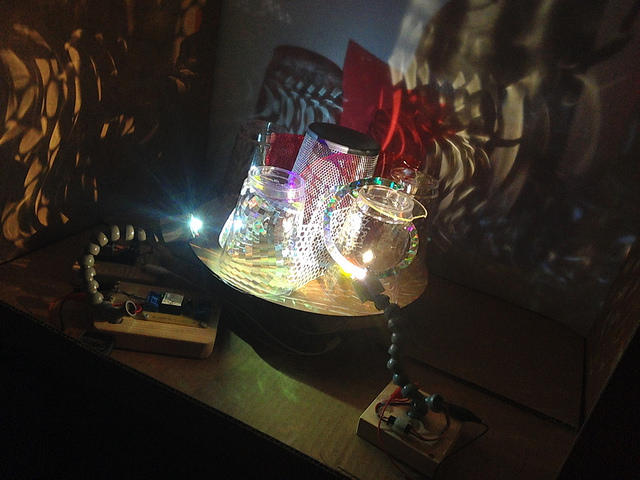
After the starting point stations, we asked people to work in pairs and spend about forty-five minutes constructing a light play vignette. There were some pretty interesting engineering challenges where people took advantage of the cardboard boxes and mounted the lights and motors to the top of the stage. 
Some of the groups built delightfully dramatic moving scenes. We only brought the prototype color changing lights as a demo (since we don't yet have a full set) but I'm excited about the possibilities for using them to really play up the story, mood, and characters in these displays.

As usual, it was a really magical environment as we began to stack the light boxes to make a wall of color and shadow. Again, using our fairly recently developed cardboard box set not only allows us to travel with the stages, but also creates a really beautiful display.

Everyone took photos of the wall with their camera phones, a common phenomenon at the end of this activity.

The video of the entire wall in motion really captures the variety and complexity of the scenes. Participants commented on the conincidental interactions of the stages and how some of the adjacent scenes seemed to blend together.

After the whole group admired the wall and shared some thoughts on the process, Lianna led a discussion about the implications of this activity to our role as educators. We showed some photos how this activity can be done in more low-cost ways and demonstrated our latest experiments with adding programmable lights and motors through scratch.
It's always fun for us to do tinkering workshops with educators, who naturally bring in a lot of ideas of how these activities could look in a classroom, library, or after-school program. Someone suggested integrating the art, science, music, and drama projects in this activity, a multi-disciplinary approach that we appreciate. It would also be interesting to see how a project like this could develop over weeks and months in the classroom in a way that we can't accomplish in the tinkering studio.
Here's the entire set of photos from the workshop. We hope to share some of the ways that these ideas get translated to other settings by workshop participants and how we can continue to evolve the activity