
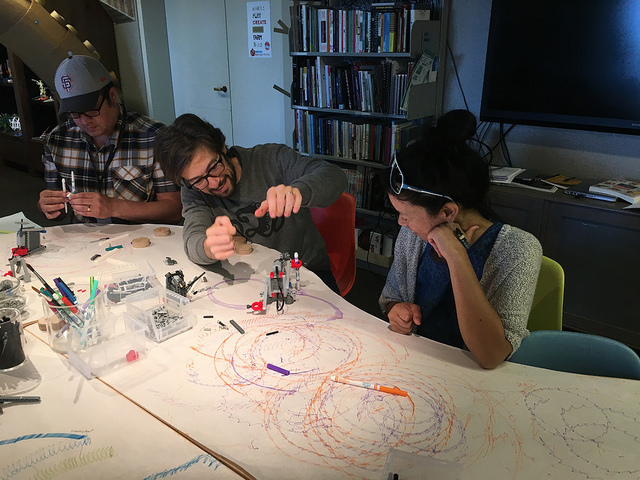
 On Tuesday, some of us who have been prototyping LEGO art machines tested out the activity with the Tinkering Studio team for the first time. We covered the tables with white paper and selected a collection of materials that we thought would give people lots of possibilities but wouldn't be too overwhelming.
 Our materials set included the battery/motor pack, some technic beams and bricks, axles, pins, pieces that could be used for weight, base plates, and angled connectors. We're still thinking of the best way to display the parts, but one of the things that we noticed was that it was important to have multiple bowls for the tiny parts on different parts of the tables.
 We set up several stations around the room with extra sheets of white paper so that people could test out their art machines. Nearby we set up the spin turntable so that people could record their designs.

We collected some books including Simple Machines and Machines and Mechanisms by the master Yoshihito Isogawa. As well, for some more artistic inspiration we set out a coffee table book on Jean Tineguely's kinetic sculptures.
 We tried to create a couple of drawing examples that showed simple motions, but made beautiful patterns when left over time. Just like any other activity, we tried to make them easy to understand and able to be improved upon.
 For something a little bit different than the normal scribbling machines activity, we gave each group a basic design as a starting point for their explorations. We purposefully created three different types of motion, linkages, vibration, and self-propulsion, to see which ones would be the most rich. It seemed to be a really nice way to ensure variation as people created mechanisms based on the initial design.
 Some of the starting points worked better than others, we unintentionally gave Karen and Jake a tricky one with a fragile base and a tall moving linkage. They had a bit of trouble trying to build up their design with extra linkage elements without the whole thing falling apart.
 However, they adjusted and disconnected the motor and start going sideways with their linkage which produced some incredible chaotic motion.
 Having extra sheets of paper on the floor and around the room for testing proved to be extremely important as many of the art machines traced large circular paths.
 It was especially important for Thomas and Meg who built an incredible somersaulting machine that flipped itself around in a big circle, splattering paint across the sheet of paper.
 We noticed groups making careful observations of the initial machine and paying close attention to each small change that they made. One of the affordances of LEGO parts is that they give the ability to make intentionally small changes and return to previous iterations.
 Mike and Lianna's close attention to their machine and minute adjustments resulted in really different patterns for each of their markers on their crank slider powered art bot.
 Another variable that we are really interested in for these art machines is being able to control the speed and direction of the motor using the power functions battery pack. Many groups experimented with the motor speed, but Karen and Jake took the experiments to a really systematic level. They created a visualization of the ways that their machine drew at each different speeds. I liked how this testing allowed them to make theories about the nature of the mechanisms as they compared and contrasted the different patterns.
 Lately we've been using our spin turntable to document the things that we were working on so after the workshop we took GIFs of each machine with the drawing in the background.
 Testing with our group gives us a great chance to learn about the activity before trying with visitors on the museum floor. We hope to run the workshop in the Tinkering Studio next week and through that, we'll continue to learn more about the ways that we can be facilitate this activity, curate an interesting set of materials, and build a supportive environment for tinkering.