
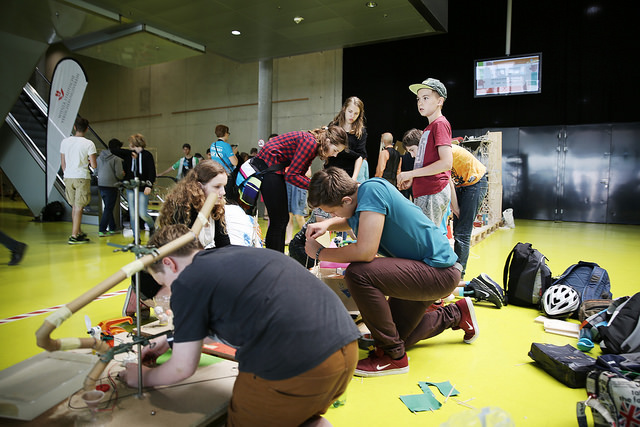
Earlier this month I attended the 2016 Ecsite Conference, a gathering of European science centres and museums in Graz, Austria. Over the next several days, I'll be posting about our pop-up makerspace sessions and a experimental series of workshops that we tried around toy dissection and reanimation. But to start, I wanted to share about the incredible Ecsite-for-All chain reaction and a tinkering pre-conference workshop that we held as a reflection on the event.
 As a way to involve the local community in the conference, the host organizations, FRida & freD, Universalmuseum, and ScienceCenter-Network, decided to facilitate a large scale Rube Goldberg inspired chain reaction. Some of the sections were completed beforehand by groups at schools and other organizations and the rest were built on site by local participants. In a brilliant logistical move, they set up the contraptions on a series of pallets that coule be moved and reconfigured, all linked together with blocks at the start and finish of each to create a truly massive machine.
The second #ChainReaction2016 it's going good! Some magic finger but great satisfaction! #ecsite2016 pic.twitter.com/n6ssSHulN2 — fabrizio stavola (@fstavola) June 7, 2016
The set off was truly spectacular with over seventy-five pallets full of complicated physical contraptions, electrical components, and artistic elements. It was really cool how the chain reaction included sections created by preschoolers to art students, and everyone in between.
 Since the chain reaction activity both exemplified many of the tinkering studio learning dimensions and provided a concrete example of a community engagement event, a group of us thought that it would be a unique opportunity for a pre-conference workshop around these topics. We encouraged participants to attend the chain reaction on the day before the session and make observations about the facilitation, environment, materials, and social interactions.
 The next morning we starting the workshop by acknowledging the potential fuzziness surrounding both of the terms "tinkering" and "community" and began to construct a working definition of each for the conversations over the course of the day. The format for talking about "tinkering" was a little playful with people introducing their partners from other countries with an attempt at pronouncing the translation for tinkering in each person's native language. And Vanessa from TRACES and E-Fabrik in Paris, led the group in an initial conversation centering on the idea that working with other communities isn't about quick fixes or outward facing policies, but more importantly should be focused on changing ourselves and our processes to make authentic connections.
 After the initial presentation and discussion, we wanted to give participants a hands-on experience to build on. As a example of a tinkering activity with a high potential for social scaffolding and collaboration, we picked an old favorite, balancing objects. Sebastian and others prototyped this activity at Open:MAKE events back in the PFA and at Maker Faire and we were looking forward to coming back to it with fresh eyes and a slightly different focus.
 Of course each time we try an activity in a new setting, we learn about different materials and ideas. This time, we were intrigued by a honeycomb packing material which made for a nice and solid, but light base for the objects.
 We thought this activity would be a good fit for the session because while people work individually to create an interesting balancing sculpture, they can then combine their creations to make a collaborative art piece larger than the sum of its parts. The end result was great, although next time I'll be sure to pack a couple of small computer fans to get the objects moving on the air for a more dynamic installation. After spending about an hour working on the activity, we had about the same amount of time to examine the learning dimensions as a tool for reflecting on the experience.
 After analyzing the tinkering activity from a learner's perspective, workshop attendees got the chance to hear about five quick experiments in involving a specific community (internal staff, teachers, local youth, makers, and refugees) in a tinkering program. Each program leader shared about why they thought tinkering experience contributed to the community building, as well as successes and challenges of the programs. It was too short of a time to really go in depth, but I think it was valuable to get a sense of different models and ideas.
 After lunch we went in depth on the Ecsite-For-All event. Just about half of the participants actually made it to see the activity the day before so we decided to print out some photos from the chain reaction and have people get into groups to describe things that they noticed either in the photos or in person the previous day.
 We borrowed a reflection technique that I learned from Ricarose Roque to debrief the ecsite-for-all event, grouping our observation into green, yellow, and red post-its representing things we liked, things we had questions about, and things to improve upon for next time. It was a great tool and a nice visual way to present reflections to the larger group.
 I hope that people left the workshop with some inspiration for how tinkering activities and events can be used to begin to build community with internal staff, local groups, and those not usually engaged with museums and science centers. It was really nice to have a specific experience to reflect on together and use as a model for how we can plan and debrief these types of events. To me it's much easier to have a shared real life experience to reflect upon as a starting point for larger discussions. And as a way to build excitment and generate interest, the chain reaction and subsequent workshop provided a great start to the activities, presentations, and conversations around making and tinkering that continued throughout the ecsite conference.