
Hello! My name is Deanna and I am a new addition to the Tinkering Studio team. As Project Coordinator, two facets of my position include facilitating an after school tinkering program (aka Tinkering Club) at Lighthouse Community Charter School in Oakland and supporting the research and practice efforts in the space through taking photos and video, recording observations of students and their projects, and conducting interviews (more information about the partnership with the Exploratorium here).
In the spring, the Tinkering Club after school program centered around electricity and circuits, building paper circuits, tiny theaters, and homemade switches. This fall, our focus has been on creating mechanisms through different projects including automata. Automata are mechanical sculptures that utilize simple machine elements like cams, levers, and linkages that result in different motions. During the Winter 2016 season, the Exploratorium has a special exhibition featuring automata from different artists from around the world. For more information, check out Curious Contraptions.
When I joined the team, the students had already made cardboard automata and were beginning to make wood automata. This project applied what they already knew about building automata and challenged students to them out of a new material. Wood is a more permanent material than cardboard, and many students commented that this is a piece that they could keep for years to come. However, it is not as easy to manipulate wood, and the tools used to work with wood can prove to be a hindrance for some and a motivator for others.
The wood automata project took several weeks to complete. Here are a few notable interactions and projects that were captured over a week midway through the project:
Collaboration

Students began their projects by building frames out of 2x4” wood. Marla* (on the left) and Thalia* worked together to build their frames. One would help hold while the other one drilled holes, drilled a countersink, and then the screw. Marla* directed Thalia* how to use the drill by walking her through the steps.
While some students chose to work independently, it was nice to see these two students supporting one another in building the wood frame. A key intersection between tinkering and STEM practices is teamwork, and seeing Thalia* and Marla* work together here demonstrated to me that they are building skills that they will be able to use outside of Tinkering Club in other contexts.
Creative Problem Solving
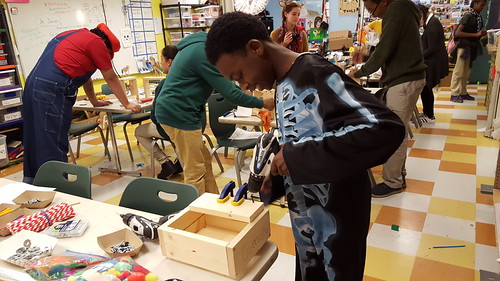
Stephan* knew that he wanted to build a car with spinning wheels on top of his automata and did not know how to build a mechanism to support this idea. He brainstormed with facilitators and decided to mount his car on the side of his box to be able to make mechanisms to spin his wheels. In this photo, you can see Stephan* attaching an additional piece of wood on the side of his frame to mount his car on. He later started sculpting the car body out of Model Magic clay and sourced toy car wheels to incorporate into his design. (Photo credit: Jean Ryoo)
Driven By Design

Rose* was drawn to the Sculpey clay we brought for decorative elements. After building her automata frame, she meticulously molded insects like fireflies out of clay. She was completely enthralled with making her clay forms, utilizing clay tools to give texture and depth to her pieces. When asked how she would incorporate her clay figures into her automata, Rose* said that she did not know yet. It appeared she saw her automata and her sculptures as separate projects and felt more engaged working with clay.
Tool Fluency

Karla* will be the first to tell you that she loves to work with drills. She learned how to use a drill at home by unscrewing things around her house (that is, until her father found out!). In class, students have varying levels of comfort around tool use. While some collaborate with partners while using tools (such as Thalia* with Marla*), Karla* confidently drilled and sanded her piece independently.
I am curious about how these students' automata will continue to evolve until then and if they choose to put these pieces (or other projects from the year) on display for others to see. For more information on automata, check out previous blog posts here, here, and here.
*The names of students have been replaced with pseudonyms.

This collaboration is funded by the Overdeck Foundation and the National Science Foundation.