In June 2024, we said goodbye to the current format of the Tinkering Afterschool program. It has been a bittersweet process to navigate through the steps it takes to properly send off an entire community of people who have spent and contributed countless hours, days, even years in our weekly workshops and as part of our community with local youth and afterschool educators. The program has been an insightful partnership between the Boys & Girls Clubs of SF and the DCYF with us in the Tinkering Studio and Exploratorium and has shaped many of our stances and practices. Since 2012, TAS has also been one of the most dedicated and vibrant expressions of a tinkering approach on learning and facilitation, and over the course of many years our program has supported thousands of young people across a long and varied trajectory of growth. Many youth knew TAS as an afterschool program, but many also stuck with us for many more years as staff: as co-designers, co-thinkers, co-facilitators, and co-creators. The spirit and practices that made up Tinkering Afterschool will continue to have life in the various other projects our team is working on, but we also want to honor the ingenuity, compassion, and impact by sharing some statistics, some stories, and some learned lessons across an infinity of memories.
Statistics
- Our professional development pathway for participant-graduates has supported the growth of more than 60+ young adult educators, many of whom have proceeded onward to careers in education, the sciences, or other forms of design work
- Tinkering Afterschool has always been committed to equity and anti-racism at all levels, and served largely youth of color and immigrant communities making up more than 68% of our attendees throughout the program’s lifespan
- 100% of our participant-graduates who became employed on-call staff in our programs have graduated from high school and are currently in or have graduated from college; some have gone onto graduate studies!
- More than a dozen of our 60+ educators have gone on to other forms of work or careers within the Exploratorium, most notably with the Visitor Experience Facilitators / Explainers
- We served on average 150+ elementary-aged youth every schoolyear, making up more than 2200+ individual youth served in our programs from across the Bay Area since 2012
- Of the five School-Based, or Beacon, sites and the eight Clubhouse locations dedicated to Boy & Girls Clubs programming in their San Francisco network, TAS built direct-services partnerships with eight of them, and provided professional development for three additional sets of site staff
- During the pandemic, Tinkering Afterschool adapted and experimented with a live virtual broadcast for programming, and tripled our weekly audience from 50-60 youth served to 180+ each week during shelter-in-place protocols across 2020-2021
- Tinkering Afterschool has showcased the constructions and artworks of hundreds of local youth in exhibitions held at the Exploratorium: across seasonal shows, in public programming engagements with visitors, and as part of the museum’s permanent collections and environmental features in the Cabinets of Curiosity
- Research connected to the programs has produced several peer-reviewed and highly-cited articles, much of which you can read here
Stories
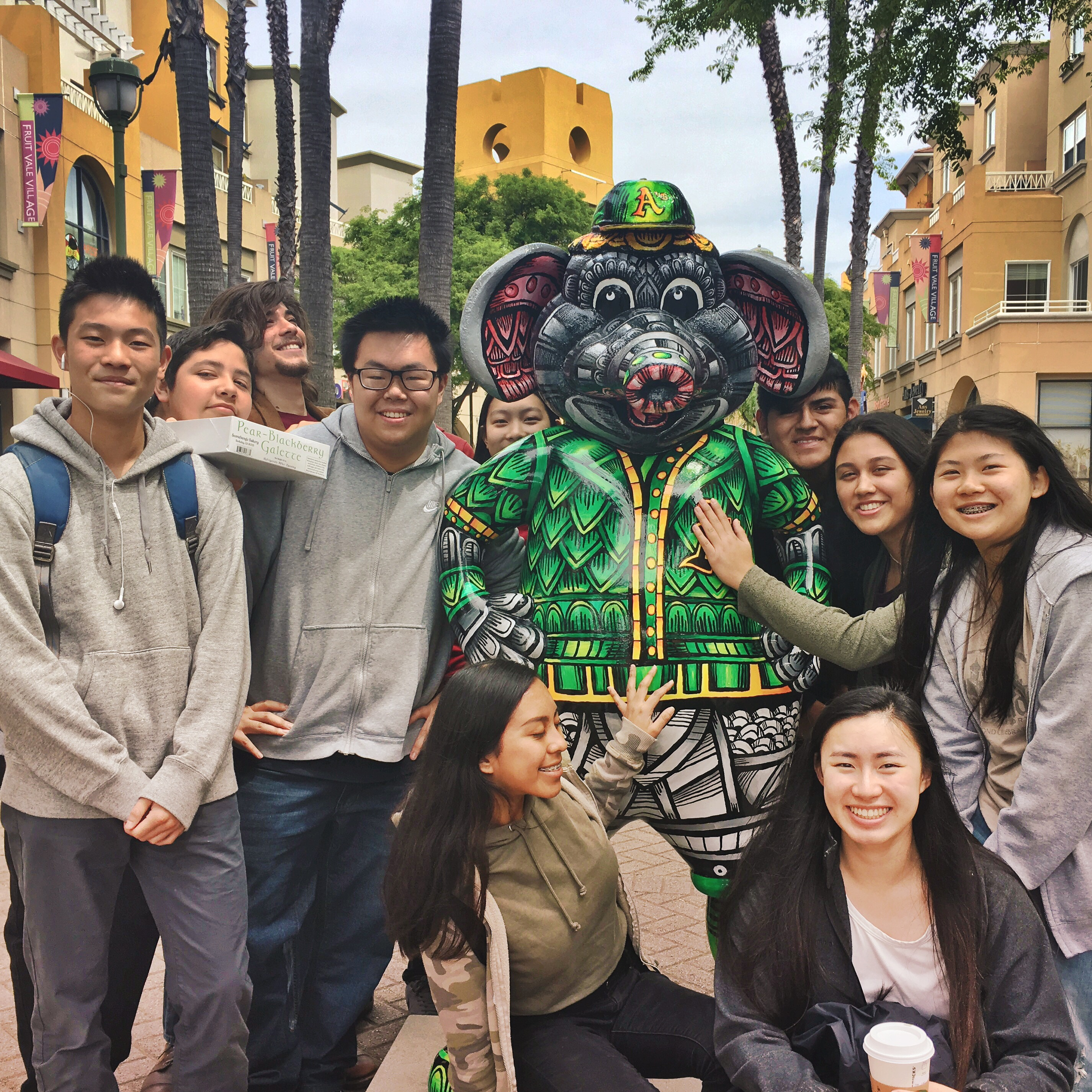
Though TAS has always been spearheaded by a dedicated few from the Exploratorium’s Tinkering Studio, the program’s success is largely the work of the many near-peer mentors employed by the program. These are alumni of our community-based programs, XTech and TAS, who share their important perspectives with us as they build on a craft of facilitation and continued design work. As new staff are invited to join our team, mentorships and friendships form organically, helping us to revisit projects with fresh ideas and approaches and to refine a culture of belonging and meaningful engagement. Here are some stories, some reflections, and some stances from many generations of our team.
Emmely Villalta
Student from 2013-16 | Staff from 2016-2022 | Currently an undergrad at UC Merced
“I know for sure that if I had not been exposed to a program like XTech or Tinkering Afterschool, I probably would not be studying engineering. I would not be where I am today. I feel like I've gained a lot of confidence in myself, and my ability to solve problems. And, like, persevere. And [I’ve learned that] if one thing doesn't work, then another thing might, and that feeds my curiosity on different things. I also feel like a lot of people that I've met that, even in engineering, they've never had that sort of experience. They've never been able to have the materials and the time to really try and figure things out on something like a hands-on project.”
Wilson Wong
Student from 2011-16 | Staff from 2016-24 | Currently a graduate student at USF
“Education is at its best when students and facilitators are able to build a rapport and common ground with each other whether that’s over the span of three minutes or three years. When you trust the people around you to ask questions that you might find are dumb or just need help on. You can draw upon the ideas of your peers, and the facilitators in order to collaboratively make something.”
“I think that when I started working with Tinkering Afterschool I didn’t even think about relationship building with learners at all. When I began working here I was fifteen years old when you’re that young, and in education it felt like to me just hanging out with my fellow peers. I viewed it very similarly to school where I would step in if someone needed help, and then back off, but somewhere in between my first two years of working here I knew that it felt off. I didn’t have that kind of relationship with the people who facilitated me, and I just realized that it took time to build those relationships. I started to inject personal details into conversations that I had in Tinkering Afterschool. My interests, experiences with schools, and advice all became a part of my facilitating experience, and gaining youth’s trust. I think that was one thing I strived to have in comparison to the formal education system was trust in those who were teaching me. I didn’t often have that, but when I did I performed a lot better, or at least made attempts to. When I think about relationship building nowadays I think about my relationships with my fellow facilitators (some of whom I’ve taught in the past), and how Tinkering Afterschool has affected the paths we’ve chosen to take in life.”
Laura Chan
Student from 2015-18 | Staff from 2019-23 | Currently an undergrad at UC Santa Cruz
“What I really like about this program, and what I do say about the program to others would be like, it approaches these ideas of science, these complex concepts, at a level where anyone can engage in it, and they can also bring their ideas into it. And that's something that I do like to mention. Like, being able to bring what you have, what you learn, or what you believe of this idea of science, and we can basically expand on what maybe something like circuitry is or what motion means, or like, colors, or dioramas. And so that's something that I like to say, is being able to bring what you have into this idea of science that feels like maybe in more formal educational settings tends to feel more rigid. And so I'd say this is like a very loose, but very inclusive and open space for science exploration.”
Sylvia Hoyt
Staff from 2023-24 | Currently an undergrad at Colorado School of Mines
“I think that at school, kids are in this track of getting assignments, and this is the thing that they have to do. And so the way that teachers know their students at school is only underneath that umbrella of students having something to do, usually from their homework. And this works well for some, but it depends on the kid. I think neurodivergence has a lot to do with whether or not this is something that the kid really finds compelling, the whole school structure. And that doesn't mean that learning isn't compelling to them; it means it's cool and maybe just isn't compelling for them. And I think that the thing that afterschool does and summer camps do, is it provides this other context from which to engage kids. It's much more social. And they get to know each other more. And I think that Tinkering Afterschool added in this element that was similar to school where there's a product you do, but it didn't have the same kinds of requirements as school. And so there was this, like, different kind of engagement slice they could slot into where there were very few rules. They got a lot of agency, and there was no real right or wrong. Whereas in school, there's lots of rules. There's usually right and wrong. And I think that a lot of good programs sit more on a spectrum. But having an afterschool program that you get to do once a week, as like a place to slot into this mindset of there not being a right or wrong, this kind of expansive explorative experience, so they get to do this really valuable thing, especially in contrast to a school system that can, frankly, be very controlling.”
Adolfo Barrales
Student from 2012-16 | Staff from 2016-24 | Graduate of USF, currently an Explainer at the Exploratorium
“Education is at its best when It meets learners at their level of interest, while also providing different avenues for learners to get involved with the material to extract meaning/moments of learning from the content. Thus, learners remain present and the learning is natural, while also dynamic and allowing for students to gain insight that is appropriate for their understanding and knowledge.”
Diego DiLallo
Student from 2011-16 | Staff from 2016-24 | currently an undergrad at CCSF
“I feel like when I first started as a facilitator, I was still very much in a student mindset of, I don't know what to do but I'll help if people need it. But I didn’t really want to talk to anyone. But as time went on, it became more like trying to at least be friendly with our students. Because then, if you can be friendly and get them to chat, I feel like the hardest thing for the student is actually to feel comfortable enough to come up with whatever the idea was that they wanted to do for the project, or feel confident in coming in and following through with what they imagined. So I feel like I set myself on a goal to be friendly and chat and see what they're interested in and to be like, ‘Okay, do that. Let me help you do that.’ Or like, let me throw a couple ideas in between, but I want you to try to follow your passion with it and for me to be as supportive as I can. And that ended up becoming my goal and my go-to.”
Ilse Cadeña-Serrano
Student from 2013-16 | Staff from 2016-2022 | Currently an undergrad at OTIS College
“When I started working, after having been a student, my world opened up like a bunch of different possibilities of different projects you could do with your hands. And as I progressed in the program, technology was incorporated. And then other types of foreign tools that I wasn’t familiar with, that I just didn't know, came into play. And when I started working in my leadership role, I was still learning about the different types of tools, you never stop becoming a learner. And it's nice being the learner while also teaching to the youth. And I learned a lot, not only in my hands-on projects and how to be creative, but also how to treat people, how to teach, how to be a good presenter, and a listener and teacher. All of it.”
“I also think we need to have more programs, more STEM programs for youth like this because if youth aren’t exposed from a young age to what these programs can do, it's not like they're wasting their time, but it's a lot of wasted potential, whereas you're not nurturing the talents or in things they can do from a young age and they might not know or they might not have the confidence to be able to do it. But this program gives you both resources and confidence to be able to do things. We definitely need more programs like this. And it's really sad that after almost 20 years, this program is ending. That's not that long, like there are fast food restaurants that last longer and those are not good for you. We should make things that are good for you last long.”
Takeaways
Over the years of fostering a program and culture around intergenerational relationships to tinkering, learning, and facilitating we have developed several mantras that help us to define what our work looks like in action. These accumulated wisdoms and historical knowledge have provided helpful strategies for building welcoming and for addressing experiences of doubt, distraction, and frustration.
These commentaries are distillations of the mantras and their origins within our program, and demonstrate the array and depth of thinking our young adult educators have brought humor, flavor, and insight into the work.
Program structures matter.
Though much of the time our team spends together is in preparation for our weekly workshop sessions with youth at the Clubhouses, we’ve developed deep appreciation for the role and impact the other segments of our workday have. One in particular is on debriefs. Debrief conversations after workshop sessions are periods of time where we can take a breather, look at and investigate student projects more closely, eat a snack, and record observations or conversations. They are important moments of team-building. They are also a powerful moment for exchanging new insights about the lives or design choices of youth, or suggesting pivots in the next week’s plans. For us they were critical moments for making adjustments and celebrating milestones.
Belonging is powerful.
At times during our workshop sessions, we are confronted with circumstances that ask us to think about what it means to address conflict or resolve disruptions. Our debrief conversations have been generative spaces where we can advocate for more sustainable forms of belonging for our community. We have explored frameworks of Transformational or Radical Inclusion as a way of sharing that our intention is to work with the histories, cultures, and contexts our youth bring to our spaces, and to thoughtfully generate new norms that more readily provide flexibility and co-ownership.
Off-Task Amazing.
This is a phrase lovingly conjured by staff over many years, and refers to the sense-making pathways that can unfold for youth as projects and constructions occur over many weeks or months of our program. We design all of our projects with multiple entry points based on a single, shared prompt meant to invite personal connections and varied outcomes. But sometimes youth need to internalize and engage with materials, tools, and concepts in their own ways before being able to conjure a construction or as an aside before reaching a next milestone in their design thinking. For us as facilitators, this means taking a step back with patience, trust, and intellectual respect for youth and to find ways to support a return route to their iteration process. Often, this happens without need for help. When this happens, we consider it an amazing expression of the flexibility that a tinkering approach can hold.
Burning is learning.
Over the years is has felt like an inevitability that someone somewhere at some point would experience the wrath of the tip of a hot glue gun or hold fear with holding a soldering iron for the first time. Rather than referring to this level of risk as a deterrent to tool use or to projects that demand tools that youth might find unfamiliar, we've found instead that building a culture that prioritizes agency - and holds reverence for the level of readiness youth bring to figuring out equipment and managing risk - is key to supporting a trajectory of curiosity, growth, and expertise. We always aim to prevent injury and tool misuse, but also understand that both can be crucial aspects of sense-making.
It has been a tremendous honor for me to have been part of this beautiful program, and to have witnessed and contributed to its long legacy of powerful work. The legacy of Tinkering Afterschool lives on not only in the stances and practices we continue to revisit and refine as educators, but also in the lives and achievements of each of our community and team and the ways they will shape the future.
We have not yet found the best way to say goodbye to an afterschool program, but we end the way we started: by committing ourselves to telling the story of how learning happens and why these experiences matter.