
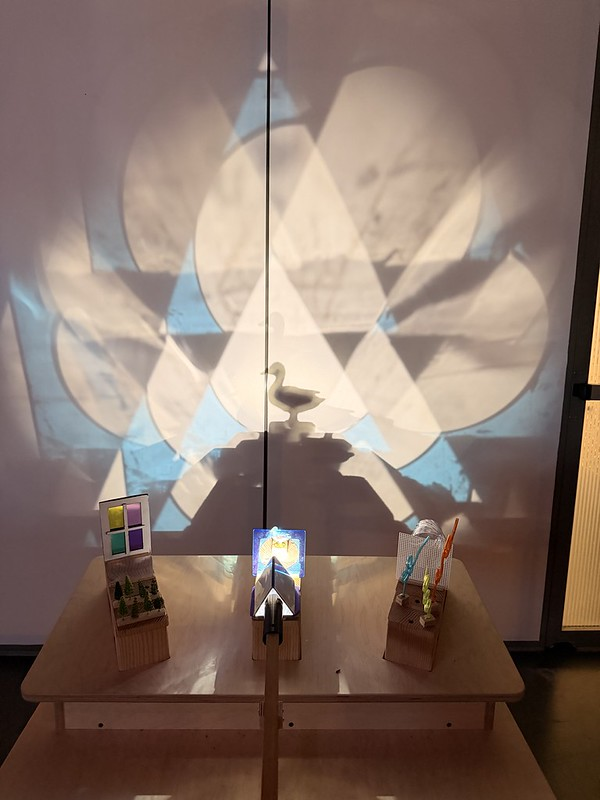
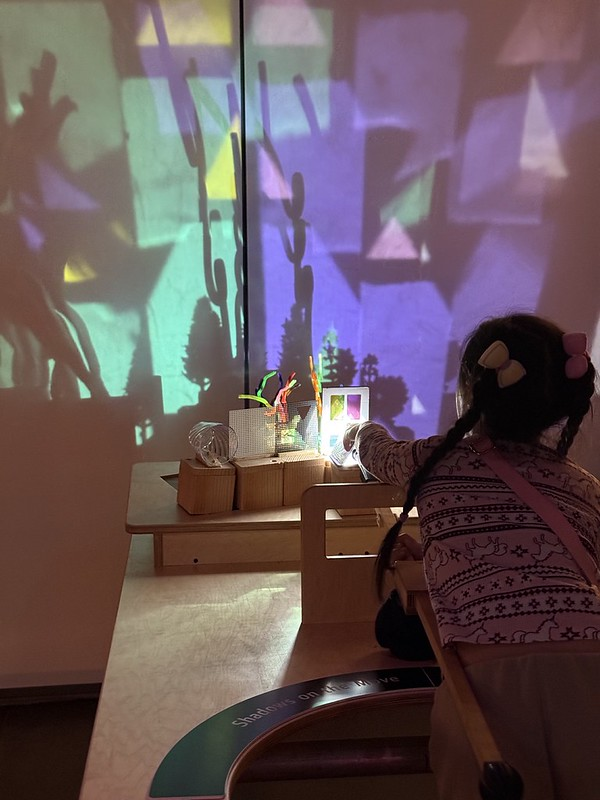
Shadows On the Move is one of several new exhibitized tinkering experiences that we’ve included in Light Play Studio, a space on the museum floor we devoted to explorations of light, shadow, color, and movement. It was situated in the Wattis Studio in Gallery 3 and ran from March 19 to April 19. Ryoko wrote a great introductory post about Light Play Studio here on the blog, and in this post I will dive a bit deeper into the process of developing Shadows On the Move.
Inspirations & First Steps
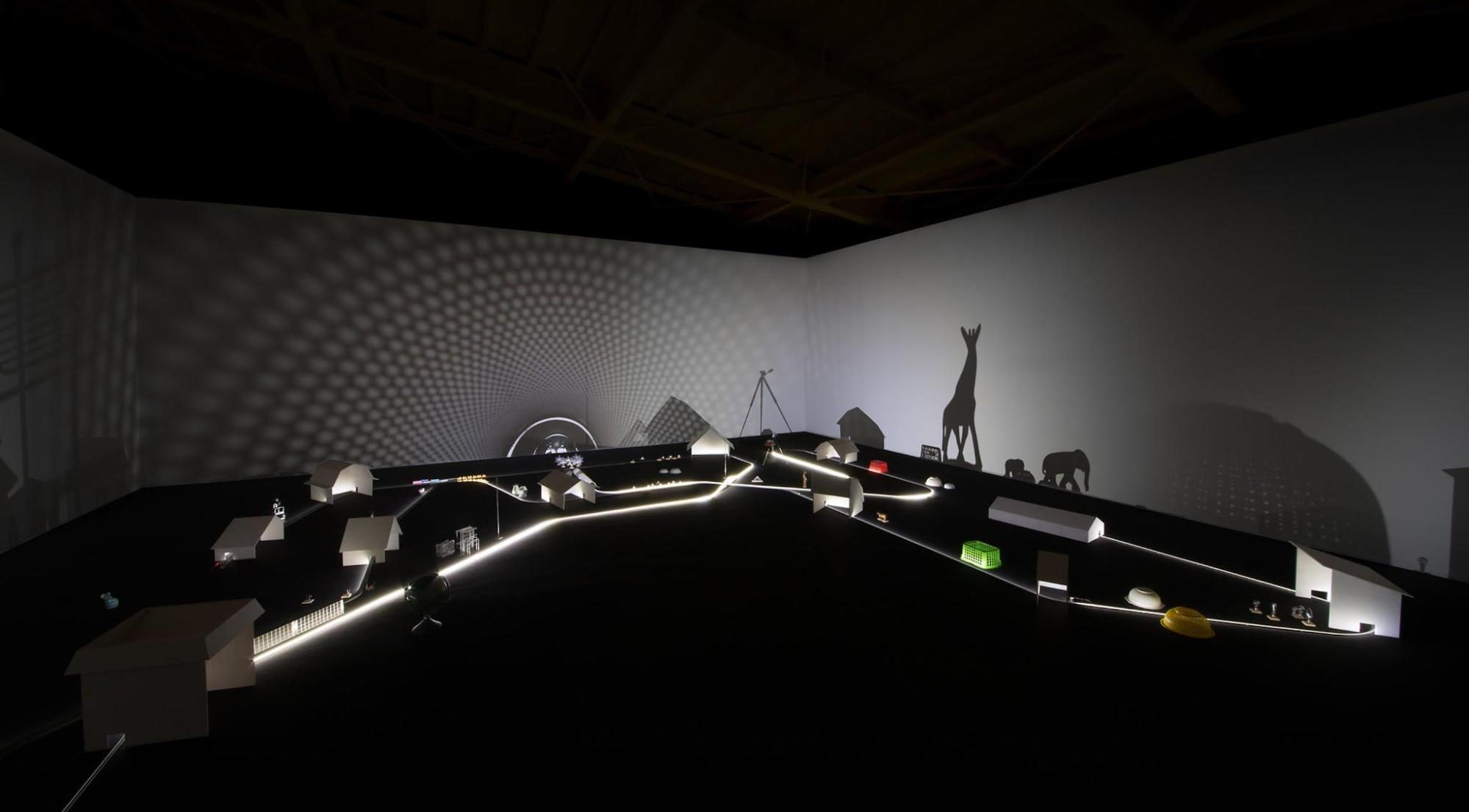
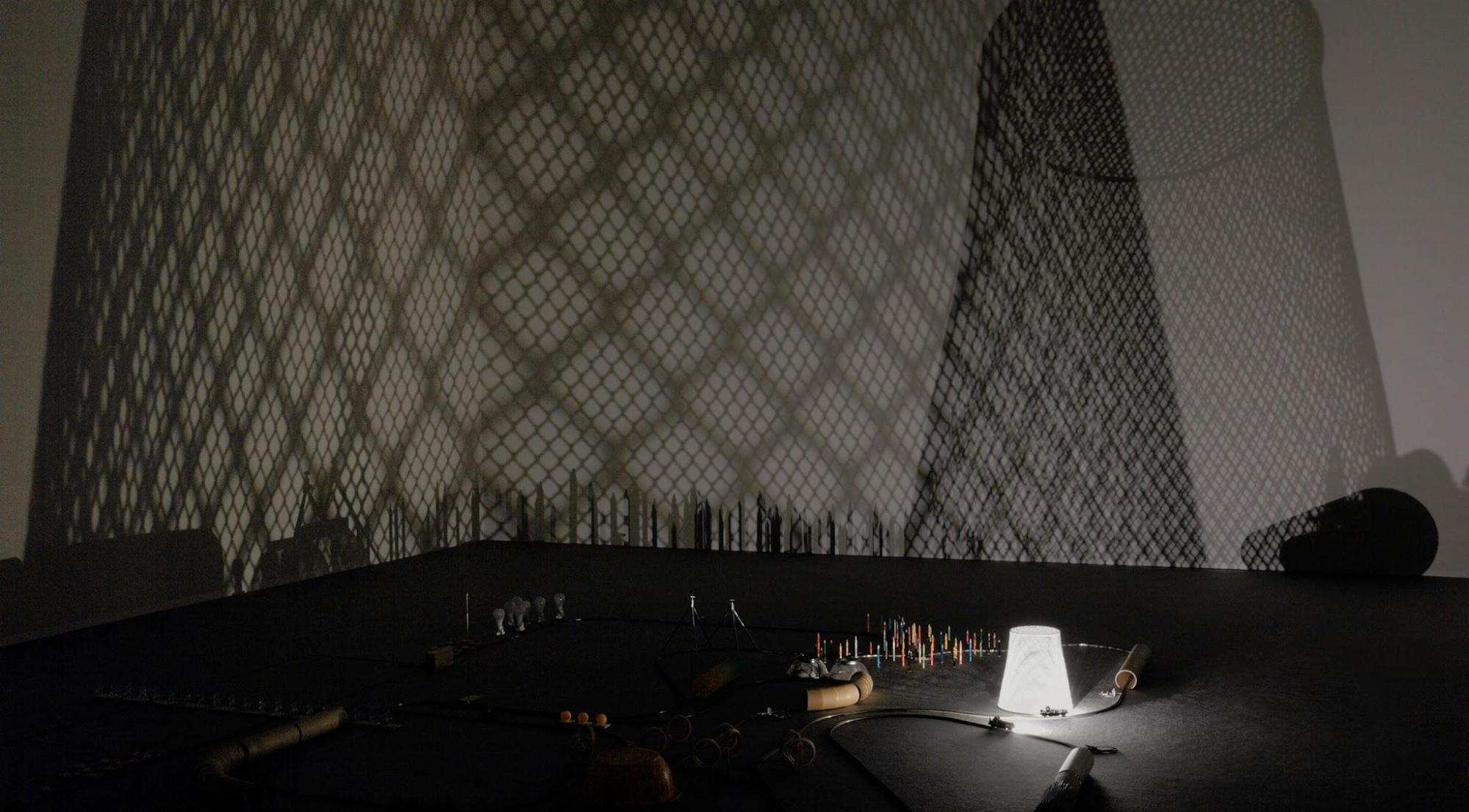
Some images of Ryota’s work, taken from his website.
As with most of our work, we started our process by identifying things we felt inspired by from around the world. We’ve been admirers of Ryota Kawakubo’s usage of everyday objects to cast enormous, room-filling shadows through the use of well-placed light sources and movement. The pieces of his that have come up in conversation a lot are his LOST series, The Tenth Sentiment, and View or Vision, most of which feature a toy train outfitted with a very bright point-light source that moves and illuminates objects he’s placed deliberately around a darkened room. We love that these items, as mundane as pinhead needles, could take on resemblances of skyscrapers or tree-lined streets, or how colanders become cyberpunk environments evoking entire cityscapes. Plastic figurines and toys of people and animals grow to become kaiju-sized within an instant before shrinking down again, and normally-unseen details like frayed edges or glued seams become visual features as their contours become suddenly spotlit. There’s a grandeur and romance to the way light interacts with these curated objects that is very cinematic and immersive in ways that static projections simply aren’t.
As we made first steps through our ideation process, remembering this about Ryota’s work helped us to define Shadows On the Move so that it homaged our source of inspiration while bringing the experience closer to tinkering: being able to move a light source in a controllable way so that changes in scale led to distortions in real-time. Ryota’s work as an artist building these large-scale installations weren’t interactive in the way we needed ours to be, immersive as they were, and it was important for us to allow visitors to be able to make choices so that objects and shadows could also evoke memory and imagination. With this spark, we then started to create prototypes to see what our ideas could make: around the mechanisms needed for the light source to be movable, and another around what objects to curate.
Michael played a huge role in developing the way we incorporated light into the project. He created a few versions of a rig, made from aluminum or wood or both, that held a flashlight and allowed someone to move it across a few planes: left / right, up / down, into / out. This meant that shadows could spill around, overlap, grow larger and smaller, and take on other kinds of optical effects based on your choices to move it. Earlier versions allowed for this movement to happen along all these planes but the mechanism felt sticky and the rig was visually obstructive, which still produced awe-inspiring effects but didn’t have the fluidity of movement that we really wanted and that we thought visitors would expect.
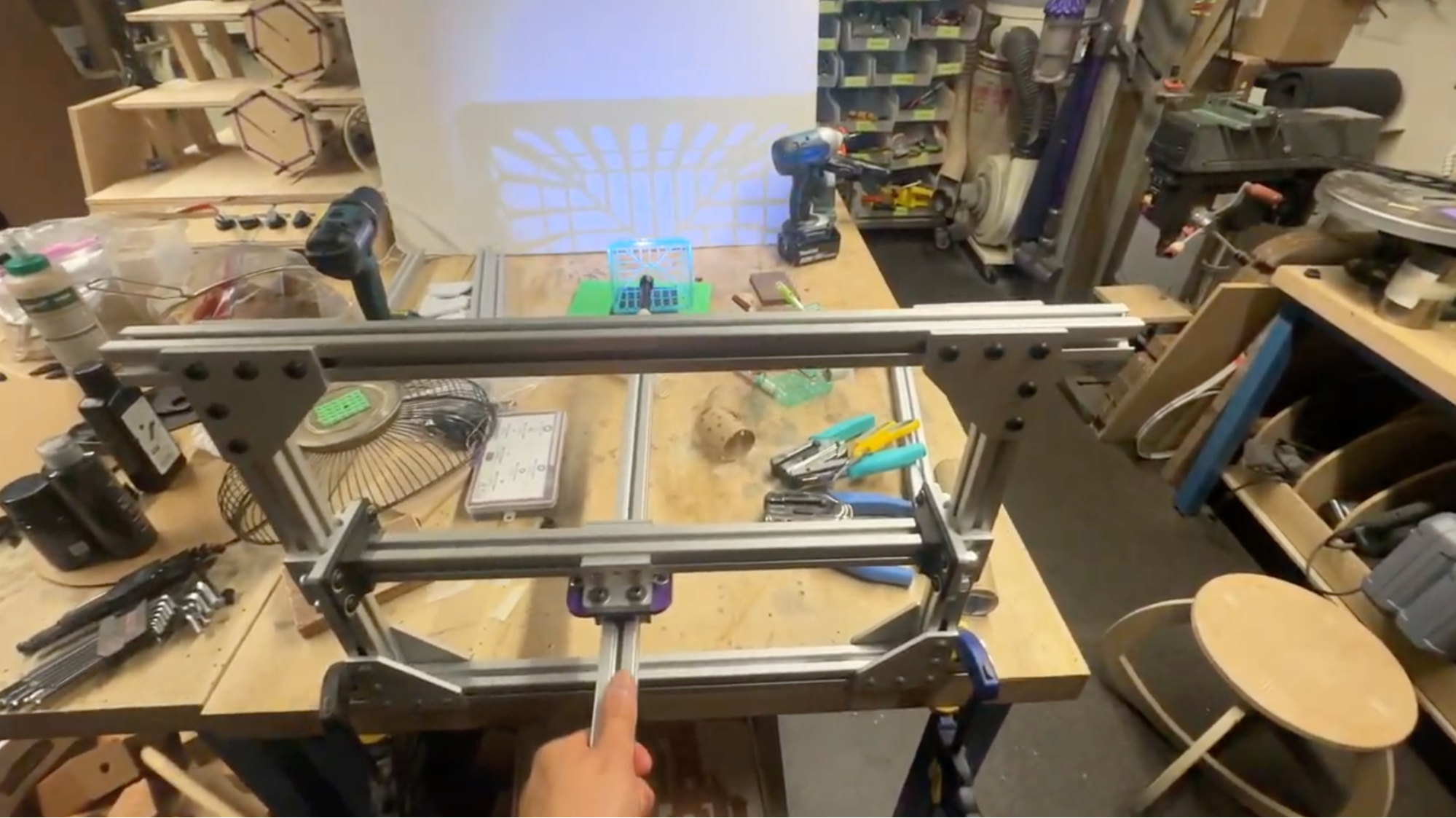
One of Michael’s earlier rig prototypes. Though the optical effects were great, the movement wasn’t quite as fluid as we wanted and the rig itself proved very obstructive to the visual feast it created. For smaller museum visitors, this simply would not do.
Ultimately, we landed on a version that took inspiration from how a camera tripod works: with a single axis allowing for radial movement from that point in all of the directions we demanded, that felt fluid and elicited very dramatic light effects. The form factor was comparatively more simplistic, too, that we felt made using it much more intuitive - critical given that our plan for this experience was for it to be largely unfacilitated on the museum floor. With the successes here, our other design choices involving the shadow-making objects became much clearer.
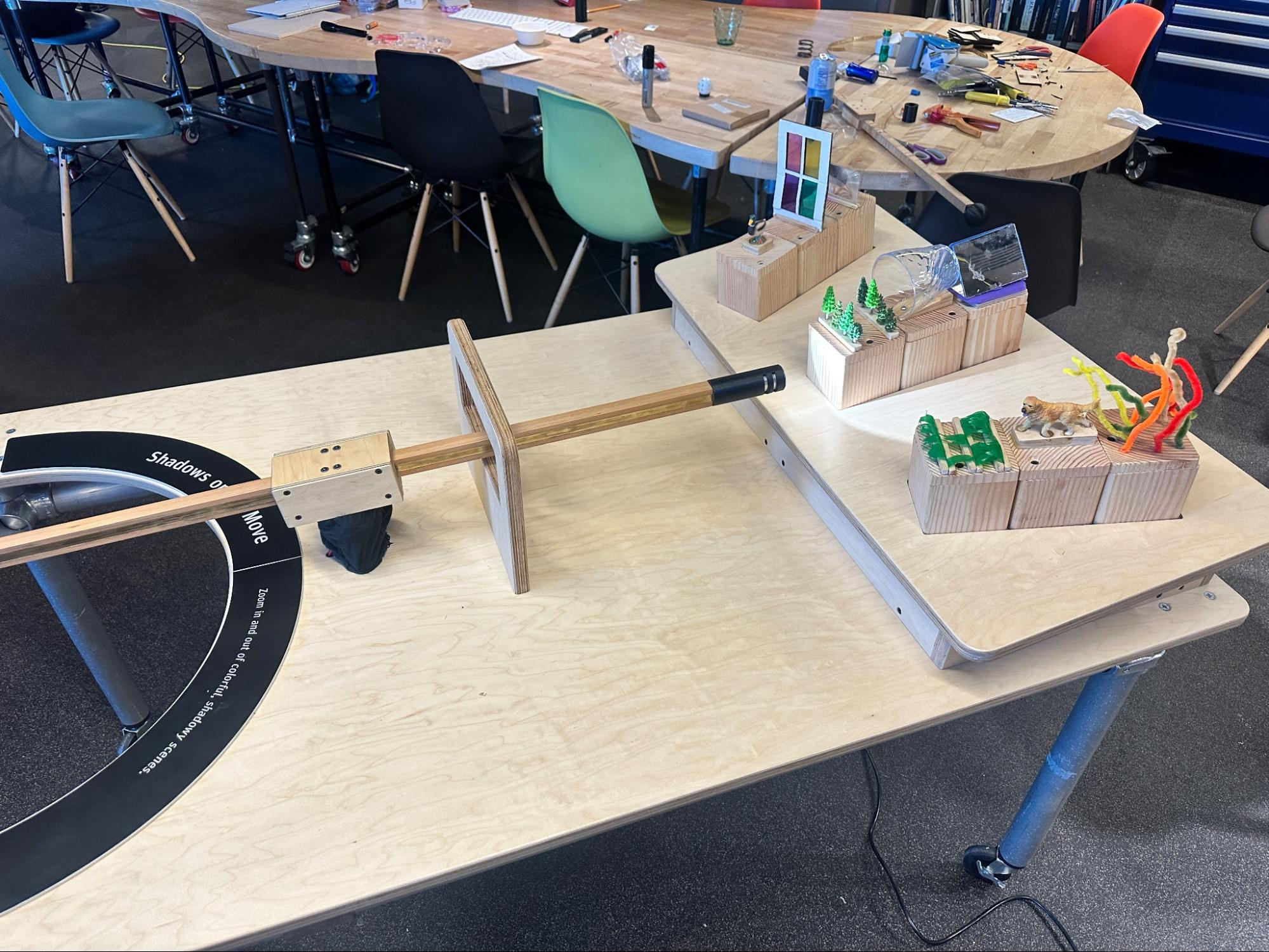
The near-final design of the light source: the long “wand” with a flashlight on the end compels in/out movement while the housing sat atop a tripod mechanism that delightfully supported radial movement in 360 degrees. We added a limiting screen in front with a cutout to keep the light source within view of the objects.
It was easy to identify objects that produced really cool effects with a light source, and years of facilitating our Light Play activity really helped with that. Our early testing led to a real abundance of selections. We found that by simply placing things like colorful acrylic or strawberry baskets on off-cuts of wood we were able to light them better and get more 3D shadows in tandem with the light rig. What took things to the next level was realizing that light moving through an object led to new heights of complexity - mechanically and optically - and that the wood blocks made for a satisfying form factor that encouraged lining the objects up for a flashlight to pass through. I devised a cardboard base with cutouts that let you create a foreground, mid-ground, and background across three different lineups along with some components I designed to act as portals, tunnels, sceneries, and lenses and our playtime with them proved delightful - and exactly what we needed to pair with Michael’s light rig. They were more design-forward than many of the objects Ryota tended to use, but introduced a baseline level of narrative and aesthetics to the experience that might have been hard to detect or muster otherwise.
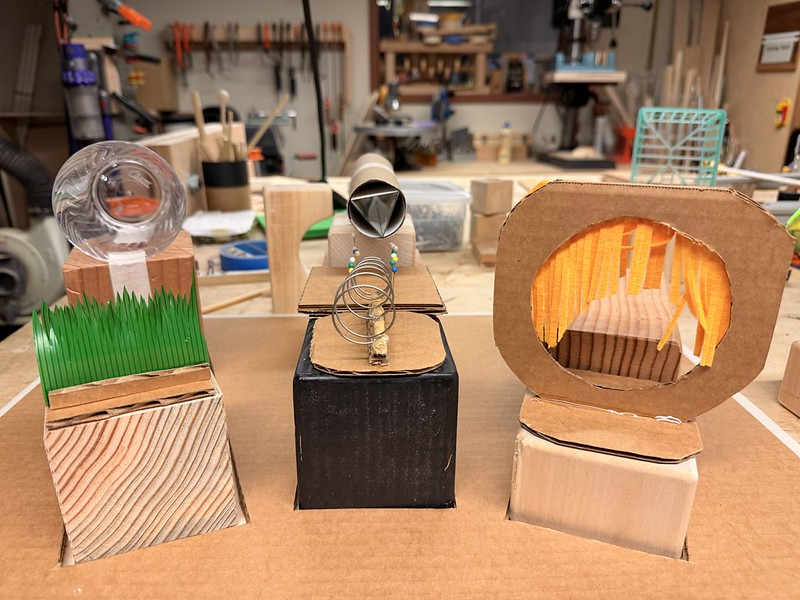
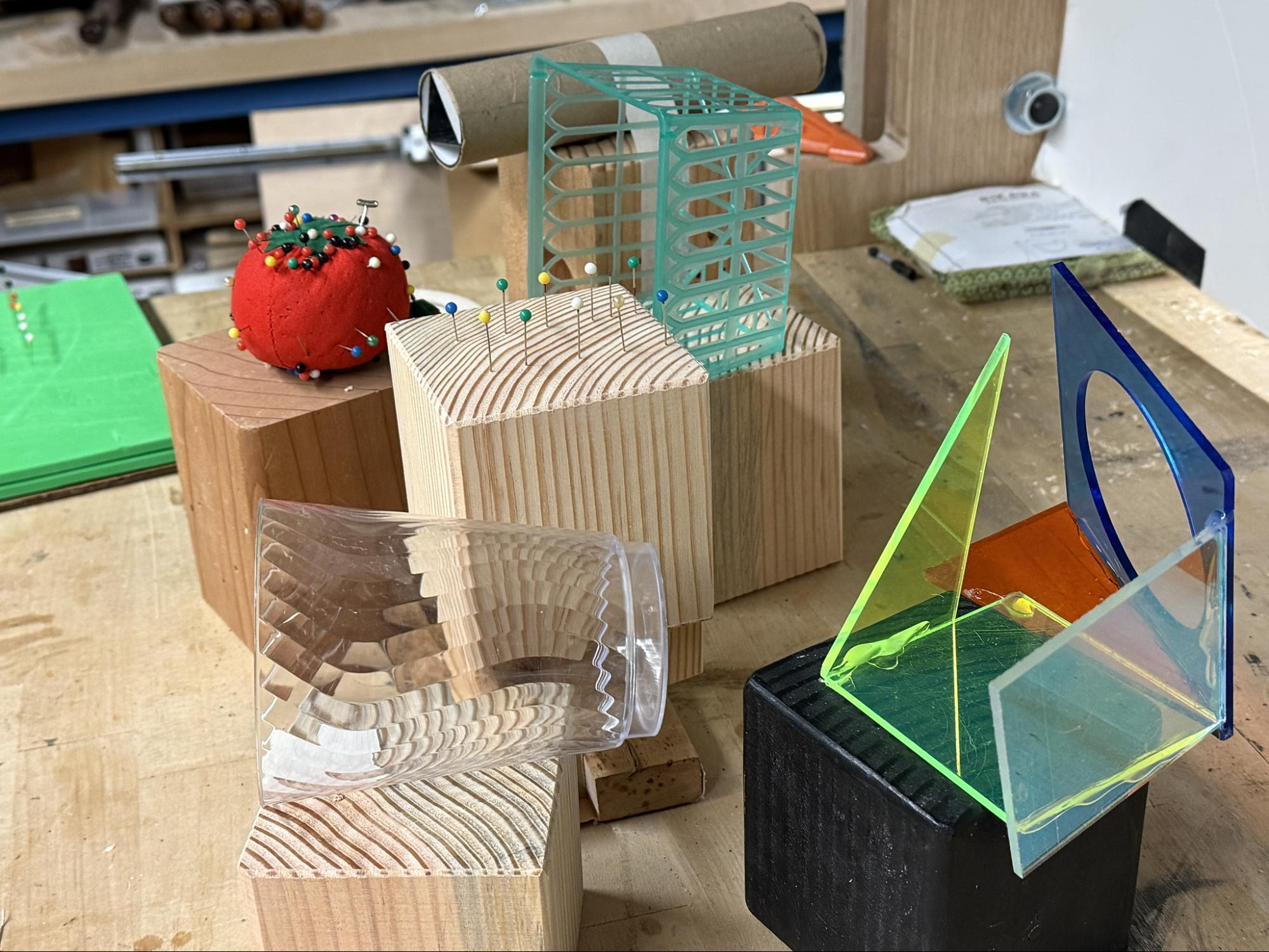
Early prototypes of the blocks for Shadows On the Move, featuring cameos by many classic tinkering materials. Note that many of the components feature “portals” and “tunnels” along the blocks that form a foreground, midground, and background and shadows to “speak” to one another.
Critical Friendships & the Popularity of a Cat
After a few prototypes, we had landed on a design that we thought was strong, and we were ready to share it with colleagues to get their feedback. We invited the Exhibit Developer team to try it out and give us their insights from technical and design perspectives, and we invited the Visitor Engagement Facilitators (VEFs) to also try out the experience and tell us what came up for them - especially around ideas for facilitation given they were largely going to be leading this once the show opened. Ensuring that the blocks and objects lined up so the flashlight could have maximum movement through and around them came from these feedback sessions (as well as how we could achieve it given the radial movement of the rig), the need to lighten the wood block bases for maneuverability, and thoughts on how we could encourage movement while also limiting the flashlight so it didn’t become a battering object (towards people or objects) all came from these sessions. We also welcomed suggestions for new shadow-making blocks, and the list flowed like a river! No single object stirred more enthusiasm than a miniature cat figurine we had slapped onto a block, and the projections colleagues created from it were hilarious and deeply affirming of our intentions - solidifying our desire to build a collection that was rife with beautiful optical effects and storytelling capabilities.
We brought our visitor engagement facilitation team, the VEFs, into co-development with us early-on and felt so many affirmations of our ideas around the cinematic and storytelling qualities of the activity.
Having colleagues who are close to us and aligned with our pedagogy, and who we trust to give us criticism, helped refine our ideas and bring out the best in them. They helped us maintain consideration for how visitors generally move through the floor and what things might be needed to invite and sustain their engagement. And, these conversations produced enough ideas for us to continue exploring for future R&D should we bring Shadows on the Move back to the floor or into new iterations - like for our annual GLOW holiday exhibition.
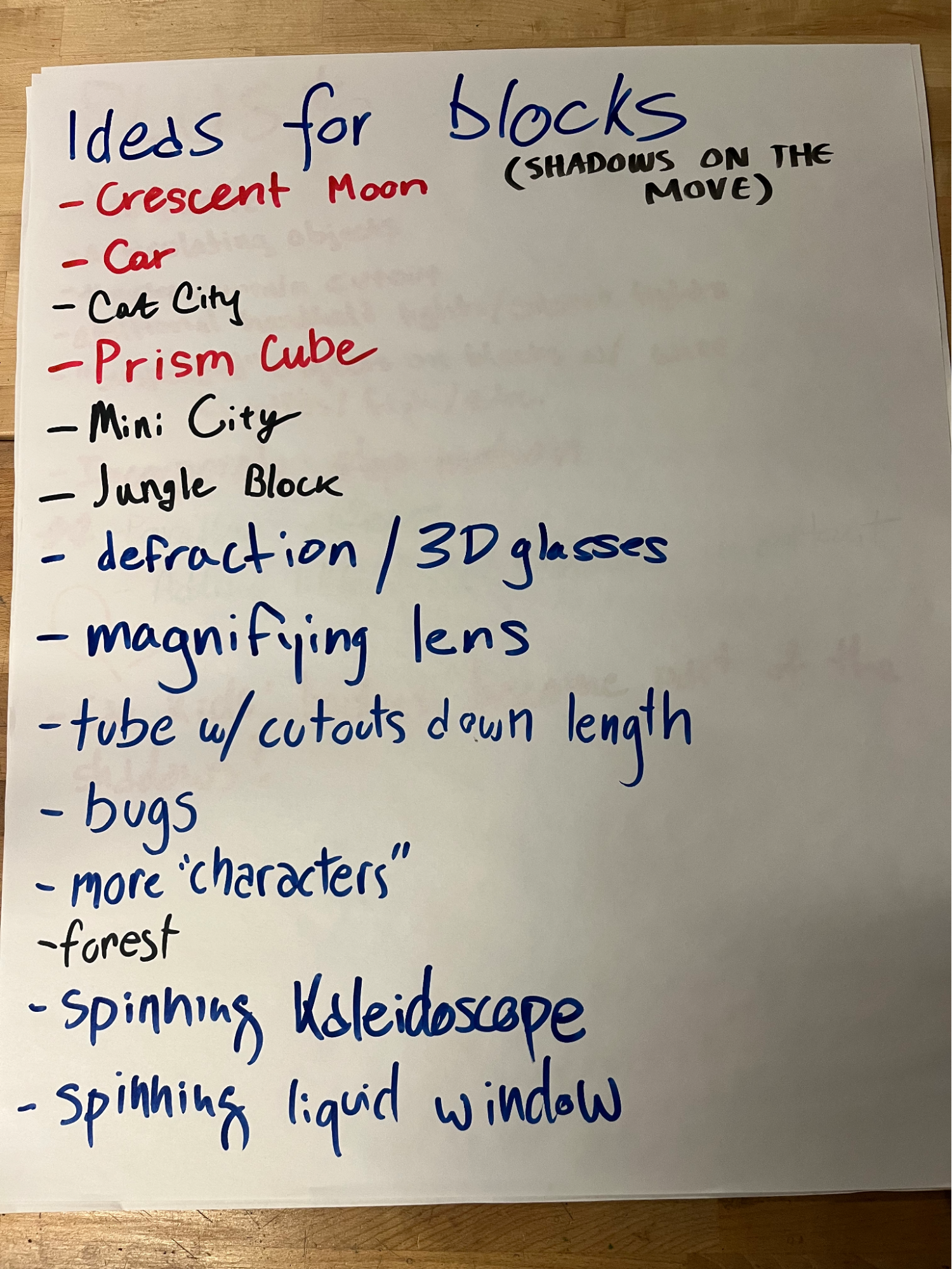
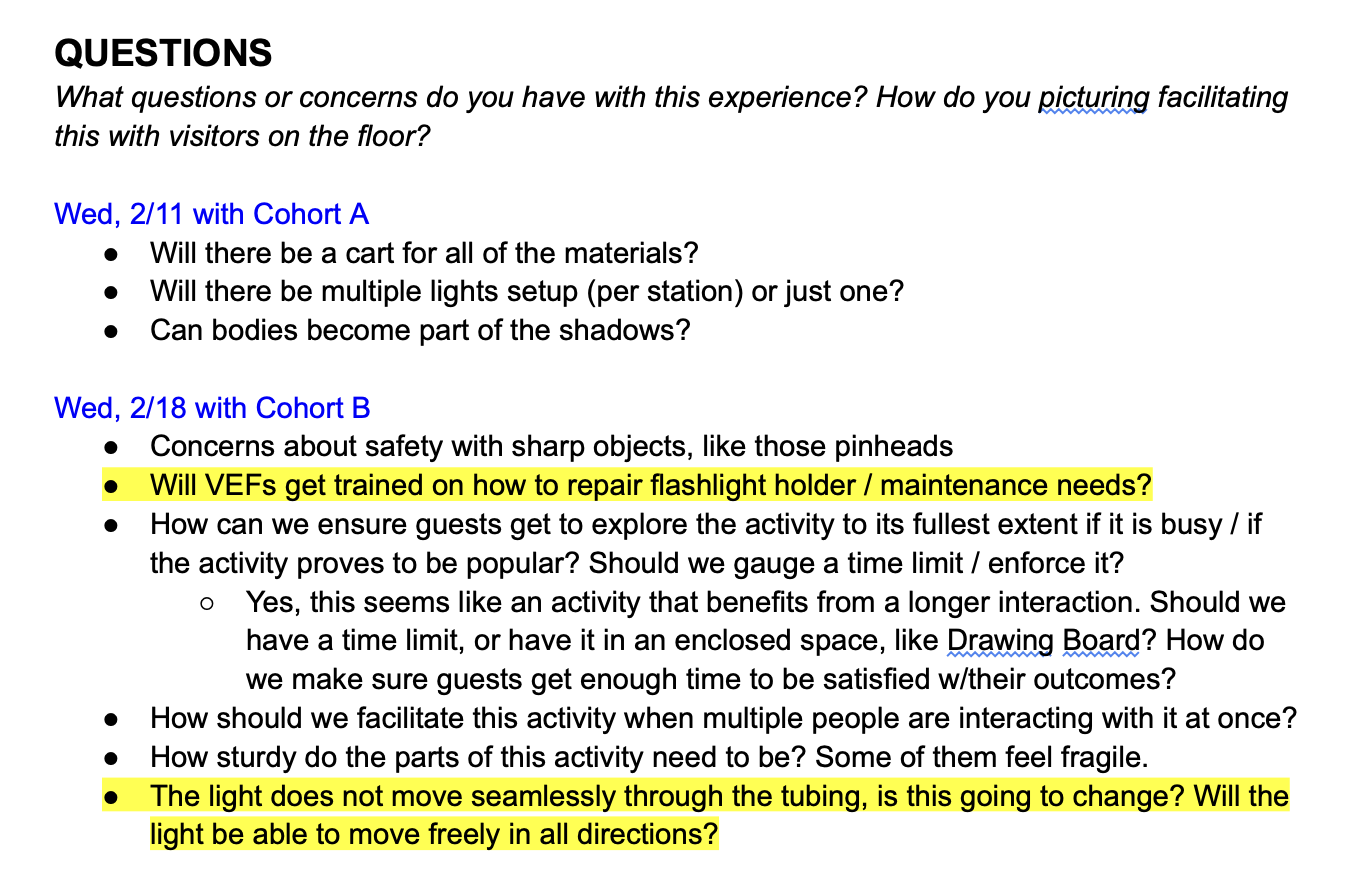
Some of the feedback and suggestions that we gathered from the VEF team. These sessions helped us address issues of safety, expansiveness & experimentation, crowd management, and so much more.
Going Live with the Public & Key Upgrades
Opening Light Play Studio to the public on March 19 came with all manner of glories and all manner of nerve-rattling as we prepared for the worst and hoped for the best. We were delighted to find our trust in visitors paid off and we had only the uncommon need to repair and replace objects - which tended to be more because of persistent use than tendencies towards destruction. We noticed lots of intergenerational experimentation and exploration, and collaborative play. And we received feedback from colleagues, visitors, and partners that tinkerability was detected and well-received throughout the body of work - an especially big treat for us to hear. We did need to make some adjustments to Shadows on the Move, however, that felt like key moments in their own ways.
Being able to see experiments with Shadows on the Move from the outside of the exhibit space was a key goal early-on, so that it could telegraph what the space was about and attract visitors.
The flashlight rig had been battery-operated all along our prototyping and testing, and we noticed after a few days that the all-day interactions on the floor were quickly draining the power. This was diminishing the impact of the shadows and optical effects, and also meant that the batteries needed to be changed much more frequently than we had capacity to do. We had devised Shadows on the Move to help attract visitors to the Wattis Studio by having its projections spill onto a semi-opaque glass wall that lined the entrance and it simply wasn’t doing that by midday when the shadows dimmed to the point of being undetectable from the other side of the glass wall. So Michael brilliantly conjured a new system for power in the rig that drew from the grid but didn’t change its maneuverability. From then on, it was possible to see how active the space was inside Light Play Studio from elsewhere because dynamic movement could be seen from the outside! Knowing that visitors were also generally respectful of the materials also unlocked a willingness to really experiment with the object blocks and to finally include things that had been on my wishlist but which I’d had hesitation to include. It was a treat to add my own riffs in reference to the objects I’d first seen in Ryota’s installations, and to close the loop on this whole journey of creation and discovery.