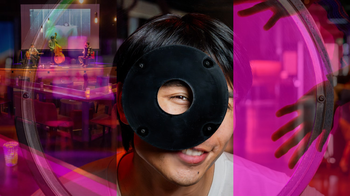
After Dark: Crafty and Calculating

Fiber arts and computer science have more in common than you think! Tonight, decode the rich relationship between traditional “women’s crafts” and technology, from the first computers inspired by the Jacquard loom, to the way that algorithms inform both textiles and math. Get cozy, crafty, and calculating—only at After Dark.
Students 18+, for a limited time only, your student ID unlocks buy-one-get-one-free After Dark tickets* at the Exploratorium’s ticketing counter.
*Not valid with any other offers or discounts. Not available online. Not valid for daytime museum admission. One free ticket per valid student ID and full-priced After Dark ticket purchased at the Ticketing Desk. Offer valid 2/5/26 to 3/26/26. Ages 18+ only, no exceptions. Must be 21+ to purchase and consume alcoholic beverages.

After Dark Thursday Nights
This event is part of our After Dark Thursday Nights series. Unplug and play with 700+ interactive exhibits exploring science, art, and perception.
With Tess Posner
Artificial intelligence can now generate music, images, video, and text at scale, expanding the creative toolkit available to makers of all kinds. But as intelligent systems become more capable, they raise profound questions about the future of creative work and the role humans play as makers, inviting us to reconsider craft, authorship, and intention in the creative process.
In this interactive session, we’ll explore what remains uniquely human in creativity, the implications of AI for artists, creative professionals, and everyday users—and the difference between using AI as a tool for replacement versus intentional integration.
Tess Posner is an award-winning AI leader and music artist. She served as founding CEO for the nonprofit organization AI4ALL focused on educating the next generation of AI technologists, and is an alternative pop singer-songwriter and producer. She co-authored The People Centered Economy: The New Ecosystem for Work and was named one of the 100 Brilliant Women in AI Ethics.
With Ahree Lee
What if the history of computing had taken a radically different path? What if every kitchen contained an electronic loom instead of a microwave?
Join multidisciplinary artist Ahree Lee to learn about how her background in Silicon Valley informs her work, and the process behind her installations that examine the hidden histories connecting weaving, computing, and women’s labor.
Get to know her artworks—featuring conductive thread, programmable LEDs, and video projections on structures modeled on mainframe computers—and her research into the early computing industry and dynamics of domestic technological innovation. Are there alternate possibilities for how technology might have developed—and still could?
Ahree Lee is a multidisciplinary artist working in the intersection of craft and technology. Her immersive installations, weavings, and videos use patterns and algorithms to question narratives surrounding craft, technology, and gendered labor. Her work has been exhibited at the Craft Contemporary Museum, Asian Art Museum, Cantor Arts Center, the Irish Museum of Modern Art, and the Sundance Channel, and has been covered by the New York Times, Hyperallergic, and Metropolis Magazine.
With MoveSpeakSpin
String figures, the imaginative designs created with simple loops of string, encapsulate both dance and math with their pleasing geometry. Join the dancers and mathematicians of MoveSpeakSpin tonight, and explore math with your body in addition to your brain! Use large loops of rope to explore polygons and polyhedra, and create your own surprising—and mathematical—movement phrases.
The MoveSpeakSpin dance company was founded by Dr. Karl Schaffer and Erik Stern. For over thirty-five years the company has included in its repertory a series of popular performances and workshops on mathematics and dance.
With SF Math Circle
Step into the puzzle parlor and exercise your logic, strategy, and creativity with games and activities from SF Math Circle—especially if you’re “not a math person.” Math is so much more than numbers and arithmetic! Sharpen your problem-solving skills and see if you can beat a partner in a game of strategy, or embark on a solo math adventure and explore different ways of thinking.
The SF Math Circle is an extracurricular math enrichment program affiliated with the Center for Science and Math Education at San Francisco State University. They provide a supportive, collaborative, and fun environment where students explore engaging, hands-on puzzles and games that involve both creativity and critical thinking.
With String Theory
Whether you’re craft-curious or an experienced fiber artist, all are welcome to this cozy gathering! String Theory, the Exploratorium's Fiber Arts Club, joins us for After Dark to host a craft corner and will be giving tutorials on how to knit and crochet. Learn these foundational techniques, contribute a square to a collaborative yarnbomb, or bring your own fiber project and stitch in good company. You can also make your own pom-poms while getting to know each other and museum staff. No experience necessary, and materials will be provided.
With Ahree Lee
Did you know the earliest computers were inspired by weaving looms? That’s because weaving is binary: each thread is either up or down, over or under, just like 1s and 0s in computer code. Try your hand at weaving as you explore the surprising parallels between textiles and computing, and take home your finished craft. No experience necessary!
Ahree Lee is a multidisciplinary artist working in the intersection of craft and technology. Her immersive installations, weavings, and videos use patterns and algorithms to question narratives surrounding craft, technology, and gendered labor. Her work has been exhibited at the Craft Contemporary Museum, Asian Art Museum, Cantor Arts Center, the Irish Museum of Modern Art, and the Sundance Channel, and has been covered by the New York Times, Hyperallergic, and Metropolis Magazine.
With Gwen Fisher, PhD
Explore designing with algorithms of cellular automata, a computational model. Each cell is colored based on its neighbors using a set of algorithmic rules, generating intricate patterns one step at a time. Inspired by Beading with Algorithms by Gwen Fisher, a vibrant mosaic emerges in this hands-on activity with each cell you color, demonstrating how mathematics, art, and computation intertwine in beautiful ways. And don’t miss this opportunity to look at more of Dr. Fisher’s mathematical beadwork.
Gwen Fisher, PhD is a former Cal State University professor, where she specialized in the mathematical education of teachers. She now works as a private math tutor for children of all ages and as an artist. Most of her artwork includes some mathematics. Her book Beading with Algorithms: Cellular Automata in Peyote Stitch is published by World Scientific. Gwen is on the Internet as Gwenbeads.
By Ahree Lee
2024
Handwoven tencel and conductive fibers, electronics, and steel
69 x 21 x 24 inches
The design of the first computers was inspired by weaving looms, and computer programming was considered “women’s work” in the early 20th century. But by mid-century, the computer industry began shifting to male domination. Artist Ahree Lee imagined the kind of technology we might have today if history had unfolded differently and computers retained their connection to looms and traditionally female labor. She wove LEDs and conductive threads strategically into the layers of double woven cloth to control their connection to an Arduino, a tiny computer, that she programmed. The woven fabric functions like the plastic substrate of computer motherboards in this eTextile installation.
With Kim Shuck
Experience the surprising shapes of baskets woven with varying angles. Basket weaving worldwide adheres to similar mathematical patterns, making all baskets “math baskets.”
Made by former San Francisco poet laureate Kim Shuck, these Math Baskets are intricate, handwoven creations that blend traditional basket-making techniques with mathematical concepts. Initially discovered by accidentally weaving too many angles into a plaited basket, Shuck now intentionally weaves pieces with different numbers of angles, resulting in delightful dynamic shapes and crunched corners.
Kim Shuck was born in San Francisco and is a citizen of the Cherokee Nation of Oklahoma. She enjoys sharing her love of origami, beadwork, poetry, and basket making . . . in other words, math of various kinds. She served as the seventh poet laureate of San Francisco from 2017 to 2021.
Upcoming Events