After Dark: Pale Blue Dot
Home sweet home—after spending a summer exploring life in space, this After Dark invites you to turn your attention to our home planet. Get to know Earth through the lens of astrobiology, astronomy, and glaciology. Learn about our planet as a living being from Ferris Jabr, the New York Times bestselling author of Becoming Earth, and discover new ways to appreciate our remarkable world with scientists, artists, and other curious minds.

After Dark Thursday Nights
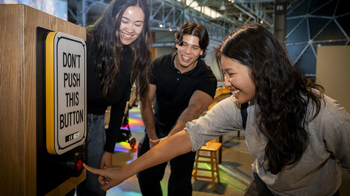
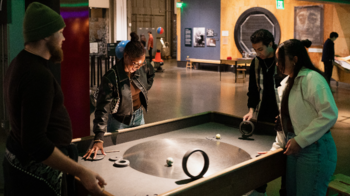
This event is part of our After Dark Thursday Nights series. Unplug and play with 650+ interactive exhibits exploring science, art, and perception.
With Ferris Jabr
Earth was once extremely inhospitable to most forms of life—how did it become a thriving living system? Join science journalist and bestselling author Ferris Jabr at this fascinating lecture. Discover how life not only adapted to our planet, but also helped transform it into a cosmic oasis. From oxygen in the atmosphere to the formation of continents, hear from Ferris about how life—and our species—inform the origins and future of Earth.
Ferris will be signing his book Becoming Earth after the talk. Don’t forget to stop by the Exploratorium Store to grab a copy!
Ferris Jabr is the New York Times bestselling author of Becoming Earth and a contributing writer for The New York Times Magazine. He has received fellowships from Yale, MIT, and UC Berkeley, as well as grants from the Pulitzer Center and the Whiting Foundation.
Earthrise tells the story of the first image captured of the Earth from space in 1968. Told solely by the Apollo 8 astronauts, the film recounts their experiences and memories and explores the beauty, awe, and grandeur of the Earth against the blackness of space.
Directed by Emmanuel Vaughan-Lee
Produced and Written by Adam Loften & Emmanuel Vaughan-Lee
Edited by Adam Loften
Cinematography by Adam Loften & Andrew David Watson
Original Music by H. Scott Salinas
Emmanuel Vaughan-Lee is an author, Emmy and Peabody Award–nominated filmmaker, and a Sufi teacher. He has directed more than twenty documentary films, including Taste of the Land, The Last Ice Age, Aloha Āina, The Nightingale’s Song, Earthrise, Sanctuaries of Silence, and Elemental, among others.
With David Grinspoon, PhD
Earth has been transformed by life before—and it is being transformed again. Join astrobiologist David Grinspoon to trace the planet’s journey, from the rise of oxygen-producing microbes to the age of humans. What does it mean to inherit planetary influence, and how can understanding our place in Earth’s story help us imagine its future? Together, we’ll explore what it takes to move from changing a planet to caring for one.
Dr. David Grinspoon is an astrobiologist and Senior Scientist at the Planetary Science Institute. His research focuses on climate evolution on Earth-like planets, potential conditions for life elsewhere in the universe, and planetary-scale human influences on the Earth system.
With David Grinspoon, PhD
Got questions about Venus, Earth, Mars, or NASA’s upcoming DAVINCI Mission? Stop by for an informal conversation with astrobiologist David Grinspoon and explore the fascinating similarities and surprising differences between our neighboring worlds.
Learn about how Venus and Mars are reshaping our understanding of rocky planets, and all the ways that studying our celestial neighbors is helping us better understand Earth. Bring your questions and join the conversation!
Dr. David Grinspoon is an astrobiologist and Senior Scientist at the Planetary Science Institute. His research focuses on climate evolution on Earth-like planets, potential conditions for life elsewhere in the universe, and planetary-scale human influences on the Earth system.
With Ryan Watkins, PhD
Join Dr. Ryan Watkins for a firsthand look at NASA's return to the Moon. Artemis II marked humanity's first journey to the Moon's vicinity in more than 50 years, carrying the first woman, the first person of color, and the first Canadian on a lunar mission. Along the way, the crew captured remarkable views of Earth from deep space, offering a fresh perspective on our home planet.
This talk will revisit highlights from the Artemis II mission, explore the crew's observations of Earth from lunar distance, and look ahead to the upcoming Artemis III Low Earth Orbit test mission—one of the next steps toward returning humans to the lunar surface.
Dr. Ryan Watkins is a Program Scientist in the Exploration Science Strategy and Integration Office at NASA. She served as an Observation Planner and a Crew Data Analyst in the Science Evaluation Room in Mission Control during the Artemis II mission, where she helped plan out the observations the Artemis II crew took during their lunar flyby.
With Helen Amanda Fricker, PhD
Hear from a NASA scientist about the newly selected EDGE mission, which takes the measurement of Earth’s vital signs to a new level with advanced imaging lidar technology.
Tracking height over time is something many of us do routinely—for example, when families mark a child’s height on a wall. Over the past 50 years, satellite radar and laser altimetry have been doing the same for Earth, generating its growth chart and giving us important insight into how our planet’s landscape has changed.
With advanced imaging lidar technology, NASA’s next-generation EDGE mission will take this legacy to the next level. By mapping ice, forests, and land in remarkable detail, EDGE will advance our understanding of Earth’s systems, improve monitoring of critical resources, and provide the knowledge needed to make better decisions for our future.
Dr. Helen Amanda Fricker is a glaciologist and professor at the Scripps Institution of Oceanography, where she leads the Scripps Polar Center. She has been a leader of NASA’s ICESat and ICESat-2 missions, and is the Principal Investigator of NASA’s EDGE mission.
With Vivian White
How likely is it that life exists beyond Earth? Join us for an interactive exploration of one of astronomy’s biggest questions. Work in small groups and imagine the likelihood of other intelligent, communicating species in our galaxy. Share the latest discoveries, make predictions, and discuss the chances that we'll make contact with aliens.
Vivian White is the director of education at the Astro Society in San Francisco, where she designs curriculum and runs NASA's Night Sky Network, a nationwide coalition of astronomy clubs.
With Ash Tutika
Join handpan artist Ash Tutika for a contemplative soundscape inspired by the natural world. Weaving together original compositions and spontaneous moments shaped by the energy of the space, Ash invites you to slow down and reflect on our shared experience on Earth.
Ash Tutika is a Bay Area–based handpan musician who has been practicing and performing for more than ten years.
With the Design for Nanomanufacturing Lab
You’re an astronaut in space and something just broke . . . trouble is, the hardware store isn’t exactly easy to reach. 3D printing could work, but the lack of gravity is an issue. Enter computed axial lithography (CAL) printing: using light and photosensitive liquid to print objects on demand, even in microgravity.
Meet the researchers from UC Berkeley who successfully printed items in space using their SpaceCAL printer, watch a demonstration, and learn how you can make your own CAL printer using their open source instructions.
Based at UC Berkeley, the Design for Nanomanufacturing Lab invented the computed axial lithography (CAL) printing process. They have been pushing the boundaries of it since, from glass printing, to printing for vertical farming, to making the technology completely open source.
With Tinkering School
Traversing Mars requires the right kind of off-road rover! In this hands-on activity, use materials to modify the wheels of a small robotic vehicle and see if you can get it up and over a pile of lava rocks. If you get (literally) stuck, facilitators from Tinkering School will be present to suggest changes and keep your rover cruising.
Founded in 2005 by Gever Tulley, Tinkering School believes that kids are more capable than they know. The School encourages children to use real tools to solve real problems, learn through doing, collaborate and make friends, and build things bigger than ourselves.
With Kaitlin McArdle and the PACE Explainers
Join us for an exploration into how big our Solar System really is! We’ll look at the relative sizes of eight planets and examine their distances from the Sun. Get ready to play with some clay and paper as we get to know our planetary neighborhood!
Kaitlin McArdle is an exhibit developer at the Exploratorium working on new hands-on experiences for our floor. Before the Exploratorium, she studied physics, astronomy, and studio art, and taught about the night sky at a space-themed informal science education camp.
Participants in the PACE Program (Professional Advancement and Career Exposure) are staff ages 17–21 who gain valuable supplemental work experience in a variety of Exploratorium museum departments.
With Ernest Aguayo
What does the Moon do besides light up the night sky? Join us to discover how our closest celestial neighbor shapes life on Earth. Play with a simple model to explore how the Moon and Sun create the rhythms of the tides. Uncover lunar science through a hands-on demonstration, and dive into lunar phases, craters, space exploration, and the many ways the Moon continues to influence our planet.
Whether a curious toddler, an engineering major, a parent, or a museum educator, Ernest Aguayo has spent a lifetime pondering and sharing the wonder and beauty of science.
Upcoming Events