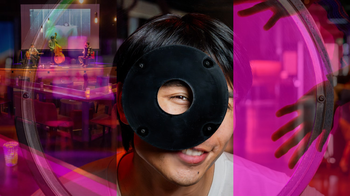
After Dark: Quantum Leap

What does the future sound like? Take a leap across music, technology, and the universe tonight. Listen to songs composed with a quantum computer. Find the harmony—and discourse—between artistry and innovation, and get to know the quantum tools reshaping our world. From subatomic matters to exciting conversations, this After Dark will open your senses to the boundless possibilities of the universe.
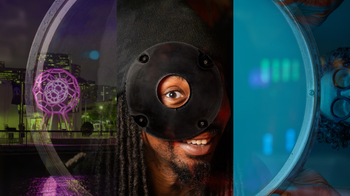
Image Credit: Tiange Wang, I-Yang Huang

After Dark Thursday Nights
This event is part of our After Dark Thursday Nights series. Unplug and play with 650+ interactive exhibits exploring science, art, and perception.
With Dr. Katie McCormick
Navigate mazes and set up secret communication channels using the principles of quantum mechanics. In this workshop, you'll play quantum games powered by IBM's quantum programming SDK, Qiskit, and see firsthand how superposition, interference, and entanglement let players pull off unbeatable strategies. Along the way, you'll learn the essential ingredients of quantum computers, what they're good at, and where their limits lie. No quantum background required, just curiosity and a willingness to let your intuition about reality get bent a little.
Katie McCormick is a quantum computing educator at IBM Quantum, where she writes courses and makes videos for the Qiskit Youtube channel. She has a PhD in physics from CU Boulder.
With Eduardo Reck Miranda, Jason Robinson, and Tiange Wang
If humanity steps beyond Earth, how will our culture, art, and music reshape themselves?
Join us to experience quantum superposition and entanglement, translated into otherworldly soundscapes. Quantum music pioneer Eduardo Reck Miranda will talk about the dawn of quantum computer music as well as his own work, brought to life with reactive visual art projections.
RSVP to save a seat, or join the standby line in case a seat opens up.
With Sarah Wallin Huff
While modern technology feels like an unprecedented disruption, humanity’s anxiety over automating art is a centuries-old loop. Join composer Sarah Wallin Huff for an exploration into the surprising lineage of music technology, tracing our relationship with creative tools from the ninth-century programmable flute and 18th-century musical clockworks, to player pianos of the 1920s.
Discover how advanced technology isn't about replacing the artist but an ongoing quest to expand abstract expression and explore the outer limits of what music can be. This journey culminates in generative AI and cutting-edge quantum computing, revealing that while our tools change over time, the debates over what they mean for the human spirit are timeless.
Sarah Wallin Huff is an award-winning composer, active performer, and educator based in Southern California. She holds a master of arts degree in music composition and teaches at Cal Poly Pomona, blending history, sound, and science.
With Resonance Studio
Meet the artist from 6:30–9:30 p.m.
Immerse yourself in cosmic wonders through science, color, and harmony!
Muons are secondary particles that are constantly raining down on Earth. In Muon Murmur, Resonance Studio captures the unseen nature of these energetic particles and transform them into light and music. Observe as the artwork lights up with each muon detected, accompanied by unique musical notes that create a rich visual and sonic experience.
Resonance Studio features light artist Sally Weber and optical designer Craig Newswanger, who have been collaborating since 2020. Their immersive installations explore fundamental properties of nature through light, revealing our interconnections to nature and the subtleties of how we perceive the world around us.
With UC Berkeley Center for New Music and Audio Technologies
Engage with the possibilities of magic and media spectacle through this interactive installation. Using lights, cameras, music, mirrors, and spoken word, five people are invited to participate and become spontaneous performers, challenging existing social dynamics and the museum environment.
The Center for New Music and Audio Technologies (CNMAT) is an interdisciplinary research center at UC Berkeley. Its work spans innovative composition, human-computer interaction, spatial audio, and machine learning, alongside public concerts, workshops, symposia, and freely shared software tools.
With NIST Electromagnetic Fields Group
Come learn all about the Rydberg atoms, which offer exciting possibilities for next-generation applications. From quantum-enhanced communications receivers to imaging cameras, these atoms can be leveraged as noninvasive, self-calibrated quantum sensors, helping us to directly measure radio frequency electric fields and trace them to the Internal System of Units without the cumbersome calibration procedures.
The National Institute of Standards and Technology Electromagnetic Fields Group measures, characterizes, and calibrates antennas and radiated fields of the type used in many high-performance communication, defense, aerospace, satellite, and wireless systems.
With the PACE Explainers
Learn more about quantum physics with hands-on, interactive experiences.
Participants in the PACE Program (Professional Advancement & Career Exposure) are young people between the ages of 17–21, who gain valuable supplemental work experience across the museum.
Study up on quantum physics with some of our favorite exhibits:
Zeeman Effect (Gallery 2)—Does a magnetic field affect how atoms emit light?
Interference Patterns (Bechtel Gallery 3)—In the double-slit experiment, does observing a particle change how it behaves?
With UC Berkeley Center for New Music and Audio Technologies
A camera and a screen face you as mirror and lens, while a restless field of painted light awaits your gaze. What you experience depends on your presence, patience, and attention, much like how interaction is a form of measurement in the quantum realm. Listen to experimental music, follow your inspiration, and get ready to be surprised by your own perception.
The Center for New Music and Audio Technologies (CNMAT) is an interdisciplinary research center at UC Berkeley. Its work spans innovative composition, human-computer interaction, spatial audio, and machine learning, alongside public concerts, workshops, symposia, and freely shared software tools.
Upcoming Events