After Dark: Splashdown
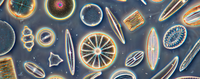
Follow the water—astrobiologists have long pursued this strategy while searching for life beyond Earth. Why is water so important to life, and what can our planet’s aquatic organisms teach us about extraterrestrials? Tonight, join biologists and scientists at Pier 15 to uncover the incredible extremophiles right here on Earth, and how they might help us make other planets more habitable.

After Dark Thursday Nights
This event is part of our After Dark Thursday Nights series. Unplug and play with 650+ interactive exhibits exploring science, art, and perception.
With Kakani Katija, PhD
Dive in and learn about the new approaches being used to discover all life in the ocean!
Researchers estimate that anywhere between 30–60% of life in the ocean is unknown to science, and these gaps in knowledge need to be filled before human activities forever change these ecosystems. Join Dr. Kakani Katija from the Monterey Bay Aquarium and explore what we know—and don’t know—about deep sea inhabitants.
Dr. Kakani Katija is a Bioengineer, Principal Engineer at the Monterey Bay Aquarium Research Institute and has a PhD in bioengineering from the California Institute of Technology. As lead of the Bioinspiration Lab, Kakani and her group investigates ways that imaging and broad community engagement can enable observations of ocean life.
With Anne Dekas, PhD
Join Dr. Anne Dekas, a geomicrobiologist at Stanford, to learn all about the amazing array of microbial life in the deep sea. Amid toxic and scorching waters, these microorganisms live, laugh, and love (metaphorically) while making critical contributions to our climate and biosphere. They might even help us find clues about where and how life can survive elsewhere in our Solar System. Don’t miss this fascinating talk about some of the most obscure single cells in our world.
Dr. Anne Dekas is an associate professor at Stanford University and a sea-going geomicrobiologist exploring how microorganisms shape the chemistry of our planet. With over 50 published studies, her pioneering research on microbial survival has earned awards from the NSF, NASA, and the Simons Foundation. She holds a PhD from Caltech and an AB from Harvard University.
With Devon Stork, PhD
Living on Mars comes with a variety of challenges: How will we grow food in toxic Martian soil? Where will we get building materials from?
The answer? Microbiology! The nonprofit Pioneer Labs is engineering microbes that could grow on Martian resources and be the first step in recreating everything we get from Earth's biosphere. Hear from one of their researchers, explore how they are simulating the Martian environment right here on Earth, and learn about how extremophiles are helping them practice for the red planet.
Devon Stork is a chemist, molecular biologist, and co-founder of Pioneer Labs, a nonprofit in Emeryville, California. He holds degrees from Harvey Mudd College and Harvard University.
With Pioneer Labs
If you want to test whether Earth life could survive on Mars, try recreating Mars here on Earth! Researchers from Pioneer Labs will share how they simulate the Martian environment on a lab bench with a chemically defined "soluble Mars soil" recipe, and how they are using it to grow life on Mars-exclusive ingredients. Check out their Mars Winogradsky columns, and be amazed by the Earth microbes that are able to survive in these harsh conditions.
Pioneer Labs is a nonprofit in Emeryville, California, launched in 2024 to engineer microbes for Mars.
With the San Francisco Microscopical Society
They can survive the vacuum of space, extreme radiation, and temperatures close to absolute zero—and they're smaller than a grain of sand. The tardigrade is the Earth's most indestructible animal, and an unlikely guide to the possibility of life beyond our planet. At this hands-on table, peer through a microscope to observe these remarkable creatures up close, and explore what their extraordinary resilience tells us about the conditions life can endure.
Founded in 1870, the San Francisco Microscopical Society is a community of aspirational, amateur, and professional microscopists in the Bay Area. They welcome all people of any age or background, from those who have not used a microscope to those who have been working with them for decades.
With the FathomVerse Team
The ocean is vast, and so is the amount of visual data scientists have collected from it—and they need your help! FathomVerse is a mobile game created by MBARI and the Monterey Bay Aquarium that turns players into real ocean researchers. By identifying and labeling images of deep-sea creatures, players help train AI to recognize marine life in thousands of hours of underwater footage. Try out the app, meet the researchers behind it, and see how a few taps on your phone can advance our understanding of the ocean.
Created by MBARI, the Monterey Bay Aquarium, and our collaborators in the FathomNet Program, FathomVerse allows everyone with a smartphone or tablet to participate in ocean exploration and discovery.
With the Facilitators
Start an algae herbarium with this make-and-take activity. Using algae samples taken from the underside of our data-collection buoy—and some professional plant-preservation supplies provided by us—you can press and preserve your very own piece of seaweed.
Dive alongside Dr. Richard Camilli and his team as they explore the undersea volcanoes off of the coast of Santorini, Greece. Testing a suite of autonomous underwater vehicles, the team hopes to imbue their robotic explorers with the same scientific reasoning of a human astrobiologist, helping us characterize alien oceans and remotely search for signs of life on distant ocean worlds.
Runtime: 23 min. 44 s.
A NASA+ Documentary Series
Shot, Edited, and Directed by Mike Toillion/NASA
By Jasmine Liang
A rollerskater finds themselves reflected in sparkly underwater universes. In this short film, Exploratorium staff and artist Jasmine explores identity, imagination, and the surprising connections they found in nature. Through playful visuals and dreamlike storytelling, discover how even tiny forms of life can become mirrors for curiosity, self-expression, and wonder.
Jasmine Liang is an artist and educator born and raised in San Francisco. They currently work at the Exploratorium and love rollerskating, magic, and the glittery microcosmos of the plankton universe.
Upcoming Events