Bay Day
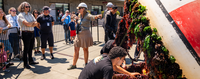
Bay Day is back! Time for our NOAA buoy to have its annual servicing, and for us to meet all the critters that have grown on the buoy in the past year. Aspiring marine scientists of all ages can join researchers and ecologists for a close look at these organisms, and even lend a hand in cleaning the buoy.
Come learn about the incredible life that's been living in the San Francisco Bay, and find out how the data this buoy collects helps us respond to climate change and sea level rise.
With Melissa Lunden, PhD
Join the Exploratorium climate team to learn all about our data-collection buoy, on loan to us from NOAA, while it is pulled up from the water and prepared for cleaning. What do these buoys do, and how do they work? Find out why it’s important to measure carbon in the Bay, and what carbon capture strategies scientists are trying to slow down climate change.
Dr. Melissa Lunden is an atmospheric scientist who has worked in air quality and climate research, leading to experiments in unconventional locations—from Sierra Nevada forests and urban subways to Grand Central Station and commercial buildings. At the Exploratorium, Melissa works across the museum to support place-based education and engagement on climate science.
With Jesse MacQuiddy
Watch a crane hoist our data-collection buoy from the water and gently land it on the pier! The buoy spends its time measuring water temperature, carbon dioxide levels, and salinity in the San Francisco Bay—and accumulating all kinds of fascinating aquatic life. Get a front-row seat to the species that have gathered on its underside over the past year.
With the Living Systems Lab Team
Ever wondered what organisms are living on our data-collection buoy? Staff from our Living Systems Lab will bring their microscopes to our outdoor gallery, and you’ll get a chance to look closely at all the algae and marine invertebrates that have collected on the buoy’s bottom.
The Living Systems Lab is the Exploratorium’s working biology laboratory. The lab cares for and cultures a variety of living organisms for the exhibits in our Living Systems Gallery.
With Ernest Aguayo
Come check out a real-time image of the Sun and observe sunspots: dark, cooler areas on the surface formed by magnetic activity. We will use a small, folded‑optics projection telescope to safely view these temporary phenomena that are not easily seen otherwise. We will also have paper and pencils on hand if you would like to make a sketch of the sunspots you notice.
Whether a curious toddler, an engineering major, a parent, or a museum educator, Ernest Aguayo has spent a lifetime pondering and sharing the wonder and beauty of science. He keeps a mental list of his Top 20 favorite Exploratorium exhibits and will gladly point out a few if asked.
With Jacquie Villa Rajerison
This program runs for 45 minutes each session. Capacity is limited; come early to grab a seat.
Join us for guided drawing lessons on elasmobranchs (sharks, rays, and skates) of the San Francisco Bay. Did you know at least eight species of elasmobranchs call the Bay home? Between pencil marks and swatches of color, get to know the anatomy and ecology of these local fishes. Connect with your artistic side and bring home your own fin-tastic portraits of sharks and rays! All drawing skill levels are welcomed, and materials will be provided.
In between guided sessions, you’ll have the opportunity to freestyle draw and chat with Jacquie.
Jacquie Villa Rajerison is a science illustrator and marine ecologist. She is a CSUMB Science Illustration program 2025 graduate, Minorities in Shark Sciences (MISS) member, and volunteers with the Ocean Science Expedition Academy (OSEA) to conduct shark research in the San Francisco Bay.
As our climate changes, what will the shoreline look like? The Exploratorium’s brand-new Waterfront Field Station is a forthcoming outdoor exhibition that will explore the causes and impacts of sea level rise and global climate change.
Come meet the creators and developers of this new work, and get curious about what it means for us to live, work, and play along California’s coast.
With Gary Fleener and Riley Zajonc
Oysters have a rich history as a food source in the Bay Area, and they contribute to the overall health of the Bay ecosystem. Join Dr. Gary Fleener from Hog Island Oyster Company to learn about bivalve biology, shellfish farming, and the ecosystem services provided by these amazing and ancient animals. Touch live oysters and learn the difference between California native oysters and other important species of the world!
Hog Island Oyster Company has been producing premium shellfish for the Bay Area since 1983. In addition to shellfish farms in Tomales and Humboldt Bays, Hog Island also hosts half million guests each year at its five oyster bars in SF, Napa, and Marin counties. Dr. Gary Fleener serves as its Senior Director of Science and Policy.
With Joseph Ramahi, PhD
Immerse yourself in the world of seaweed, guided by scientists and researchers. Get a feel of various coastal seaweeds, including sea lettuce, kelp, and others. Study them under a microscope, then learn about how these marine macroalgae are impacted by climate change—while playing an important role in scientific research.
Dr. Joseph Ramahi is a Research Team Leader for the Center for Cellular Construction, based out of SF State. Joseph is also the biotechnology instructor at South San Francisco High School. Joseph is a San Francisco local and SFSU undergraduate alumni.
With SFEI
Help scientists from the San Francisco Estuary Institute monitor plankton and nutrient levels in the Bay! See the sensors we use to keep an eye on the Bay and watch for harmful algal blooms. Use a microscope to meet the plankton that live in our Bay, create drawings of your favorite ones, and work together to keep our coast healthy and happy.
The San Francisco Estuary Institute (SFEI) is a nonprofit environmental research institute that delivers visionary science to revitalize nature in our communities. By partnering with communities, Tribal nations, and government agencies, SFEI creates cost-effective solutions for clean water and resilient ecosystems.
With Central Contra Costa Sanitary District
What happens to our dirty water after it goes down the drain? And what’s okay to flush? In this hands-on activity, make your own simulated toilet using a simple container with a water-tight lid, and “flush” different kinds of paper to see how they behave in the pipes that eventually lead to wastewater treatment collection sites and to the ocean. From your observations, decide what kinds of paper are designed to go down our pipes and what isn’t.
Ben Lavender is a Community Affairs Representative for Central Contra Costa Sanitary District, where he manages the education programs and runs public tours of Central San’s facilities. He is delighted to share the work of wastewater collection and treatment with audiences of all ages.
With EBMUD
Uncover the wild world beneath our street! Become honorary engineers for a day: pour water into a see-through pipe model, and watch how shifting ground and thirsty roots can crack clay pipes. Test your clog prevention knowledge with fun games, and discover how watching what we flush helps protect the San Francisco Bay.
Established in 1923, East Bay Municipal Utility District (EBMUD) has a proud history of providing high-quality drinking water for 1.5 million customers in Alameda and Contra Costa counties.
With Napa Sanitation District
Dive into the microscopic world of wastewater treatment with NapaSan! Discover how scientists use "liquid compost"—a bustling community of hungry, helpful microorganisms—to gobble up pollution and recycle water. You’ll get to peer through a microscope to spot these tiny eco-heroes hard at work. Check out sealed water samples to see the purification process in action, trace the map from the river to the Bay, and find out how NapaSan recycles water to keep our planet green!
Napa Sanitation District (NapaSan), located in the Napa Valley, provides wastewater collection, treatment and disposal services to the residents and businesses in the City of Napa and surrounding unincorporated areas of Napa County. NapaSan has been serving the public since it was organized under the California Health and Safety Code in November 1945.
With the San Francisco Public Utilities Commission
Bigger storms than usual are already a part of our changing climate. Green infrastructure is one approach to mitigating the effects of future downpours by building our cities to be more sustainable and adaptable.
Join the SF Public Utilities Commission to learn more about adopting a storm drain, getting a rain catchment barrel, becoming a Rain Guardian by adopting a rain garden, and other ways to make living in the city greener and more sustainable in our changing climate.
The San Francisco Public Utilities Commission provides drinking water, wastewater services, and energy to San Francisco residents, businesses, and municipal departments.
With The Nature Conservancy and the CA State Coastal Conservancy
Our coastlines are changing, but nature has a built-in defense system! Join the State Coastal Conservancy and The Nature Conservancy to discover how scientists are using native Olympia oysters, eelgrass, and wetlands to build resilient "living shorelines" that protect us from sea level rise. You’ll meet local eco-experts and find out how these tiny native oysters act as the ultimate foundation for a healthy bay. Plus, get creative and help celebrate our underwater heroes by bedazzling your very own oyster shell to take home!
The Nature Conservancy is a global environmental nonprofit working to create a world where people and nature can thrive. Founded in the U.S. through grassroots action in 1951, The Nature Conservancy (TNC) has grown to become one of the most effective and wide-reaching environmental organizations in the world.
The Coastal Conservancy is a non-regulatory state agency that works with others along the California coast, in coastal watersheds, and in the San Francisco Bay Area to fund projects that protect and restore coastal resources, helping people to enjoy the coast and to enhance climate resilience.
With Celeste Woo
Discover the remarkable diversity of nudibranchs—marine sea slugs celebrated for their brilliant colors, elaborate forms, and surprising adaptations. Explore handcrafted sculptures inspired by these extraordinary marine animals, chat with fiber artist Celeste Woo about the intersection of art, marine biology, and craft, and see how her practice of knitting, crochet, felting, and sewing can transform wool, silk, and cotton into vibrant underwater lives.
Celeste Woo is a fiber artist whose work explores the colorful and intricate forms of nudibranchs through textiles. Her fascination with these marine creatures began after taking a fiber art class with Carole Beadle at the College of Marin. Starting with knitting, she has continually expanded her practice to incorporate new techniques and materials, pushing the boundaries of what a fiber nudibranch can be.
With the Fathomverse Team
The ocean is vast, and so is the amount of visual data scientists have collected from it—and they need your help! FathomVerse is a mobile game created by MBARI and the Monterey Bay Aquarium that turns players into real ocean researchers. By identifying and labeling images of deep-sea creatures, players help train AI to recognize marine life in thousands of hours of underwater footage. Try out the app, meet the researchers behind it, and see how a few taps on your phone can advance our understanding of the ocean.
Created by MBARI, the Monterey Bay Aquarium, and our collaborators in the FathomNet Program, FathomVerse allows everyone with a smartphone or tablet to participate in ocean exploration and discovery.
With the Visitor Engagement Facilitators
Start an algae herbarium with this make-and-take activity. Using algae samples taken from the underside of our data-collection buoy—and some professional plant-preservation supplies that we’ll provide—you can press and preserve your very own piece of seaweed.
By Jasmine Liang
A rollerskater finds themselves reflected in sparkly underwater universes. In this short film, Jasmine explores identity, imagination, and the surprising connections they found in nature. Through playful visuals and dreamlike storytelling, discover how even tiny forms of life can become mirrors for curiosity, self expression, and wonder.
Jasmine Liang is an artist and educator born and raised in San Francisco. They currently work at the Exploratorium and love rollerskating, magic, and the glittery microcosmos of the plankton universe.


