
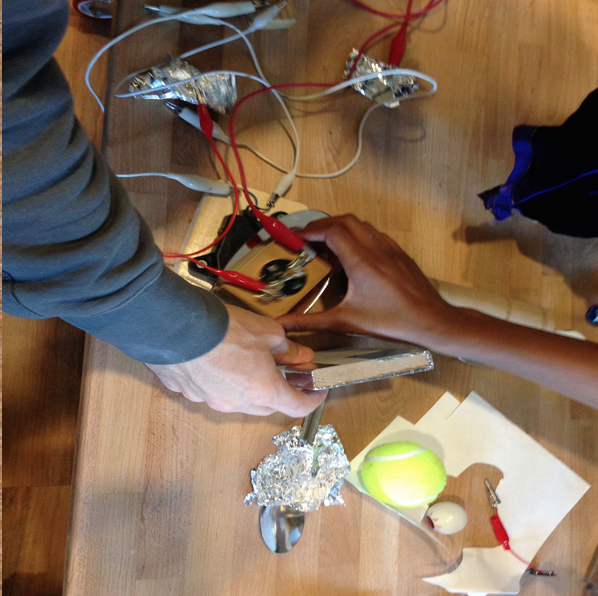
Nicole's brilliant video of the many flavors of homemade switches inspired me to write a little bit about how we tend to introduce the concept of switches in the course of tinkering activities and when moments of more instructive facilitation can allow learners to go even further in their own process of understanding.
 This summer, explainers and Tinkering Studio staff have been leading the chain reaction activity on the museum floor. In this workshop, participants build sections of a collaborative Rube Goldberg machine using a combination of familiar and unfamiliar materials. We provide a bunch of electronic components like slow moving motors, computer fans and dissected toy parts. Most kids can figure out on their own how to connect the battery to the component, but we've found that building a switch often requires a facilitator to step in and explain how it works.

Often when we notice someone grab a electronic component (or when they seem unsure of what to do next) we'll go over and ask to show them something that might help for their chain reaction. We'll bring a battery, some alligator clips, and a fairly large piece of aluminum foil over to their work station. Facilitators start by asking them to clip the motor to the battery normally so that it runs. Then we'll unclip one of the nails and insert a piece of foil and connect the other side of the foil back to the nail. Now we have a circuit with electricity flowing through the foil. We'll ask the participant to rip the foil in half and once they do, we'll notice that the electricity can't flow through the gap, so the motor stops. Then we'll ask them to touch their piece to mine and when they do the electricity flows through and the motor turns back on which is usually a moment of surprise and excitement.
 This simple switch can be triggered by a ball rolling, a domino falling, or some other physical action depending on what other components are part of the machine. We may also let them know that the foil can be switched out for other metal objects. Most importantly, I then step back to allow them to figure out a way to incorporate this idea in a way that make sense in their machine if they choose.

I think that there is sometimes the misconception that a facilitator's role in a tinkering activity is to simply sit back and watch the learners explore freely. But to me, it's more complicated than that, as there are times when offering a tip, tool, or concept can be a way to deepen the learner's interaction with the materials. In the chain reaction example, this bit of step-by-step explanation often leads to participants creating lots of different switches on their own, including many designs that we have never seen before. Just like how a good prompt or a limited palette of materials can provide more opportunity for personal expression, I think that a facilitators giving people the background in how to make a simple foil switch often lead to a deepened interaction with the activity and materials and increased possibilities for tinkering.