
Lately we've been thinking a lot about how to provide an introduction to programming through visual languages like scratch with visitors on the museum floor. As well, we've been messing around with new technologies like watercolor bot, seeed grove kit sensors, Makey Makey and other tools, to try to create activities that blend the physical and digital world. As we prototype around these ideas, we're thinking about developing new activities as well as incorporating elements of coding and programming to existing tinkering workshops.
 One of the activities that seemed like a natural fit for programming was paper circuitry. We've been inspired by the ways that Jie Qi and other tinkerers have made beautiful programmed cards, stories, and art pieces. We thought that it might be possible to use Seeed grove kit and ScratchX to allow visitors to engage in a similar process to make the lights on their creations blink, fade, and respond to sensors.

Paper circuits alone provides plenty of challenges for visitors in the tinkering studio, so when we started planning the workshop, we wanted to make sure that we dedicate enough space for people to learn the tools, experiment with the materials and test out multiple iterations. For the first trial, we ended up with the paper circuits space set up normally with an added 'programming station' against one wall of the studio.
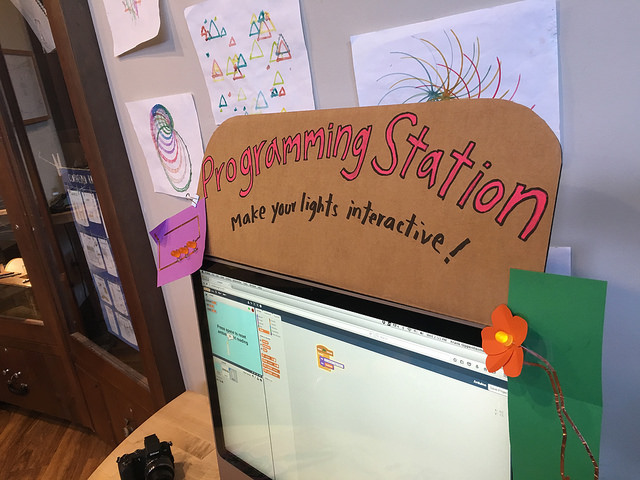
 After a few times trying out this setup with visitors, we came up with a few ways to make the space seem more welcoming and provide a lower threshold for participation. One was to add a cardboard frame above the monitor to explain the purpose of the station and place a couple examples already connected for visitors to test out before making their own.
 Additionally, the Seeed Grove parts do not come with labels so we made quick makeshift identifiers for people using some of the components for the first time. If the placement, wording, and size seems to work well, it will be easy enough to lasercut a more permanent version.
 In the several times we've tried this out, we've been encouraged that a few kids have got pretty deeply engaged with the programming, although it seems that at this point, most visitors who have spent so much time on the paper circuits are less interested in continuing with the programming. While the computer station would be fine to keep out as a auxiliary element to the experience and an option for complexification, we already have thought up a few things that we want to try out to see if we can support broader engagement with the programming elements. We are interested to experiment with the way that we introduce the activity, either starting some groups with programming or changing the placement of the station more to the front of the space. As well, different examples that play with the ideas of light sensors, blinking, or other elements may prove to be more inspiring for visitors. Lastly, I wonder if there's a lack of motivation due to the fact that the programmed elements need to stay connected to the computer with scratchX. Other technologies exist like Jie's circuit stickers or programming attinys with the normal arduino IDE as ways to build the programming into the card and let people take it with them.

The other idea that we may push deeper on is adding servos or other motion elements to the cards. I made a quick paper scene of a train that incorporated elements of pop-ups and paper circuity as well as a sound played from the computer. I have the feeling that more experiments in this area could make for some more inspiring uses for the programming and could reach a little bit more towards the idea of storytelling through digital and physical elements. Ryoko has been experimenting with moving flowers and animals that could be incorporated into paper circuit creations and Tinkerer-In-Residence Tim Hunkin has been creating some "peep shows" that I think could be a really fun direction to take some of these prototypes. We're looking forward to continuing to explore these ideas in ways that allow for personal expression and problem solving on the part of the visitors to the workshop.