
Our recent experiments with LEGO tinkering have led to some quick and dirty collaboration, iteration, and research and development mostly over twitter using the hashtag #LEGOtinkering. It's been really inspiring to see the ways that other teachers, librarians, museum educators, and designers have taken initial ideas around art machines, sound makers, and linkages to new and unexpected places.
While this shared prototyping process can feel like a natural extension of our tinkering practice and gives us the possibility to work together with other educators and designers without the added step of developing formal networks, it's also based on having the proper tools and experiences to fuel the process. To me, our initial explorations suggest that not only are informal educators hungry for ideas, they also are deep wells of knowledge and can make substantial contributions when given the right invitations and provocations.
Searching through the stream of tweets can feel overwhelming, but I wanted to try and share a few examples that I think demonstrate different possibilities for collaboration through social media using the hashtag #LEGOtinkering. And as we celebrate the tinkering tenets during the National Week of Making, I wanted to reflect on some of the ways that these new (for us) tools allow us to redefine what it means to engage in rapid prototyping with a growing community of tinkerers.
#LEGOtinkering Push Me Pull Me first version. @scratch controls motor. #art @Lightnin99 @ryanejenkins @smartinseb pic.twitter.com/odCos8vjw2
— Josh Burker (@joshburker) April 4, 2016
Twitter allows us to document the process of iteration. Josh Burker, an educator we’ve been collaborating with, shared four versions of a single art machine in consecutive twitter posts. This real time documentation and reflection gives us insight about how increasingly complex ideas come about. And since LEGO allows for consistent and systematic building, it’s easy to follow along from a distance and recreate designs.
Manufacturing motor / battery chassis developed @TinkeringStudio for @LEGOfoundation Idea Conference. #LEGOtinkering pic.twitter.com/quIE4nHq9R — Amos Blanton (@Lightnin99) April 7, 2016
In the our own process of developing activities, we believe in sharing ideas and getting inspirations from others. Through the #LEGOtinkering posts, we are also able to share designs rapidly with a large number of long-distance collaborators like Amos Blanton from the LEGO Foundation. One example where we really took advantage of this is the base model for art machines. We went through a bunch of different versions of starting points for the mechanisms and we all could quickly post and try out new models.
first attempt to share a file on thingiverse - #LEGOtinkering pen holder - let us know if it works @tinkeringstudio https://www.thingiverse.com/thing:1486961
— Ryan Jenkins (@ryanejenkins) April 13, 2016
Doing a little #LEGOtinkering with some NXT Mindstorms. Thanks @TinkeringStudio for the STL file! @ThinkeryATX pic.twitter.com/fRkj9Jrm5r — Alex Morrison (@alexmwmorrison) May 17, 2016
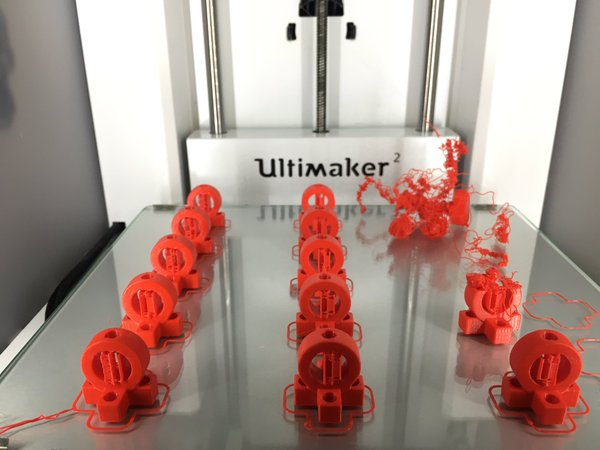
In our workshop, we've been skeptical of 3D printers in general as a makerspace tool due the limitations of speed and reliability, but the #LEGOtinkering collaboration has made us rethink the usefulness of the tool. The first .STL file that we shared was the LEGO pen holder. This customized piece has allowed many more people to join in the art machines prototyping and it was really cool to see the physical part spread around the country.
Thanks again @TinkeringStudio @ryanejenkins ! I learned how to use a #lasercutter today! #makered #makerspace pic.twitter.com/OkZru1HjYG
— Colleen Graves (@gravescolleen) May 18, 2016
We also shared a lasercutter file on instructables for an acrylic pegboard to use as a base for linkages. One of the coolest things about sharing the digital file was that it gave people like Colleen Graves, a librarian and maker educator a reason to try out a new tool that might expand possibilities for her learning space.
More #LEGOTinkering inspired by folks at @TinkeringStudio and @joshburker - y'all are great. pic.twitter.com/lyILryRsVf — Patrick Ferrell (@PBFerrell) May 3, 2016
Another #LEGOtinkering collaborator, Patrick Ferrell, got the same file but turned it into something completely unexpected and delightful. We've found that with sharing digital files, it's more interesting to provide parts for exploration instead of finished products. This way, we are also surprised by the outcomes and can continue the circle of inspiration.
During today's 'Mech. Systems' class we're #LEGOtinkering with gears and cams in the Innovation Lab. #JHLILmakers pic.twitter.com/UrFxFlohsQ
— Freeman Library (@FreemanLib) May 23, 2016
We use our workshop space on the museum floor as a R&D lab to inviting visitors to prototype not fully fleshed out ideas alongside our group. The #LEGOtinkering group explands that pool of testers and lets us gain experiences from trials in classrooms, festivals and conferences. The Freeman Library, Patrick's makerspace in Houston, TX, has been doing lots of LEGO tinkering workshops and we've been learning alongside them about where participants in the workshops can take the ideas next.
LEGO drawing machine #LEGOtinkering pic.twitter.com/4VPZUKw6Z2 — KatKelley (@KatKelley16) June 18, 2016
.@KatKelley16 I have been dreaming somebody would build this! Brava! #LEGOtinkering
— Josh Burker (@joshburker) June 19, 2016
I think my favorite thing about our #LEGOtinkering collaboration is the way that it allows educators and designers to encourage each other as they share prototypes. Each time someone posts something new, there are a bunch of excited tweets celebrating the ideas!
Prototyping #LEGOtinkering with @littleBits power + #LEGO + zip ties thx @ryanejenkins @exploratorium #MakerEd pic.twitter.com/QJVcEJL0d0 — Maureen Reilly (@MaureenrReilly) June 14, 2016
Although we've started with the #LEGOtinkering hashtag and have developed a community around the LEGO activity prototyping, it will be interesting to see where the R&D process takes us. As collaborators get interested in other materials or products, do we branch off into different threads or is there some other deeper way to organize the tweets?
I'm new to the whole Maker movement and fell in love with #LEGOtinkering but where can I find these Lego kits.
— Gianna Colson (@GiannaColson) June 9, 2016
And lastly, as we continue to use these technologies to share the prototyping process, we have to respond to the challenge of figuring out how to include new educators in the community who have quesitons about materials, tools, and activities. It will be important to continue to expand the network of collaborators
Many of these #LEGOtinkering ideas are old but there's power in encouraging people to figure things out for themselves. And through that revisiting of topics, new ideas emerge almost magically. But I think there's trick to creating shared problem spaces that are open ended enough to allow for personal expression but focused enough that ideas are related and can spread quickly. Creating these types of social media collaborations can allow for both rapid prototyping and long-term investigations. Even if it seems messy from the outside, I think going through the tweets can show a lot of deep thinking and demonstrates social scaffolding in action, even in the online world.
Over the next few months we'll be continuing the #LEGOtinkering explorations with art machines and linkages, as well as starting sky parade, balancing objects and other new ideas. We'll also keep investigating the potential for twitter and digital tools so join in the process with #LEGOtinkering hashtag and help us develop these ideas further.
This blog post is part of a series of Tinkering Studio posts highlighting a variety of ideas during the National Week of Making. weekofmaking.org